




Smoking cessation statistics describe several different things. Wanting to quit, making an attempt, staying smoke-free for a defined period, and having quit at some point in life each need their own measure.
The national smoking picture has changed. A preliminary 2025 estimate put US adult cigarette smoking at 9.1%, according to the National Center for Health Statistics. The final 2024 estimate was 9.9%, reported in a separate NCHS analysis. Those figures measure current smoking, rather than the percentage of attempts that succeeded.
The findings below keep their original years, populations, and follow-up periods. The US surveys cover adults 18 and older. They do not describe ARRØ customers or an exclusively 21-and-older population.
Key Smoking Cessation Statistics at a Glance
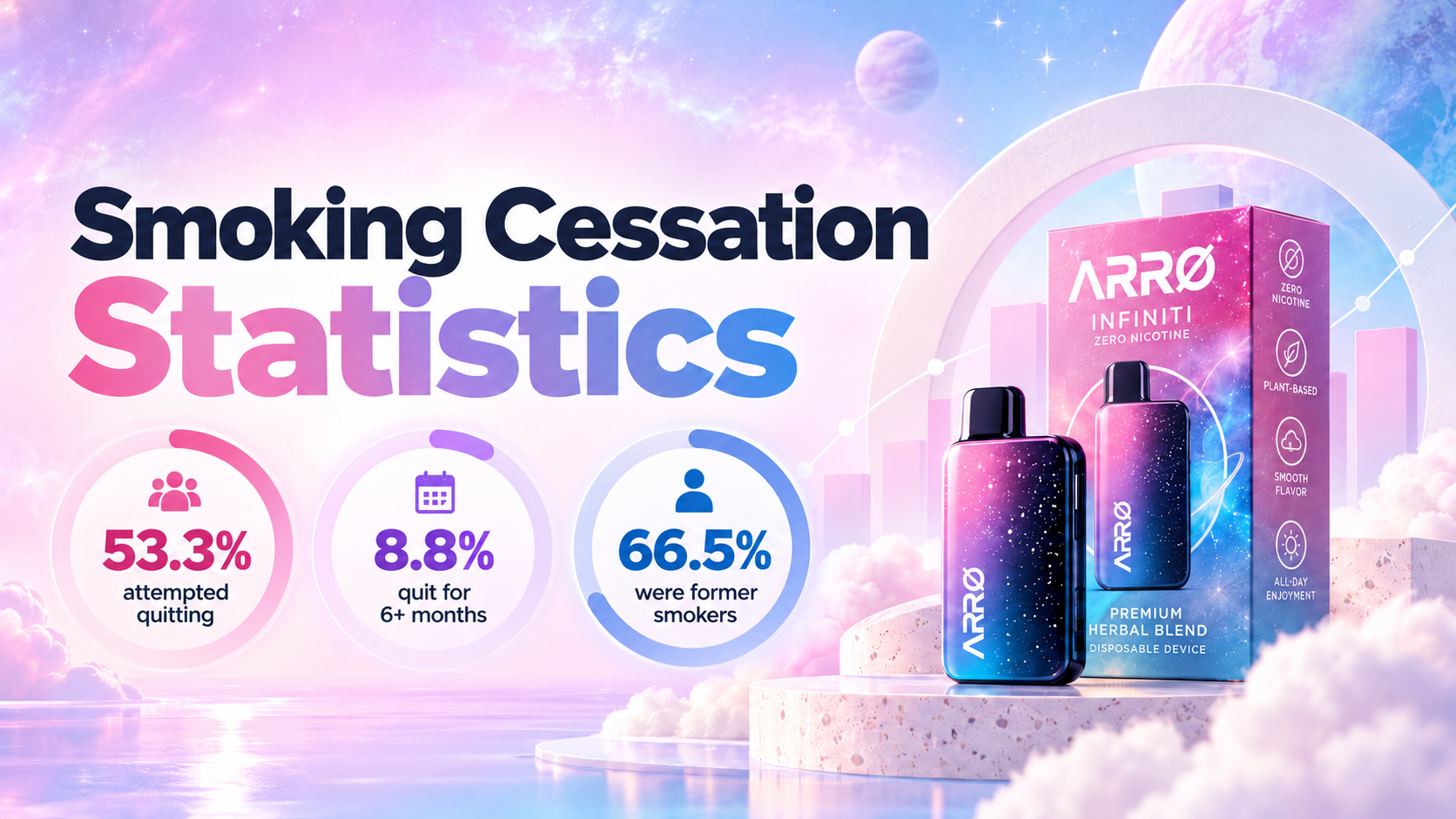
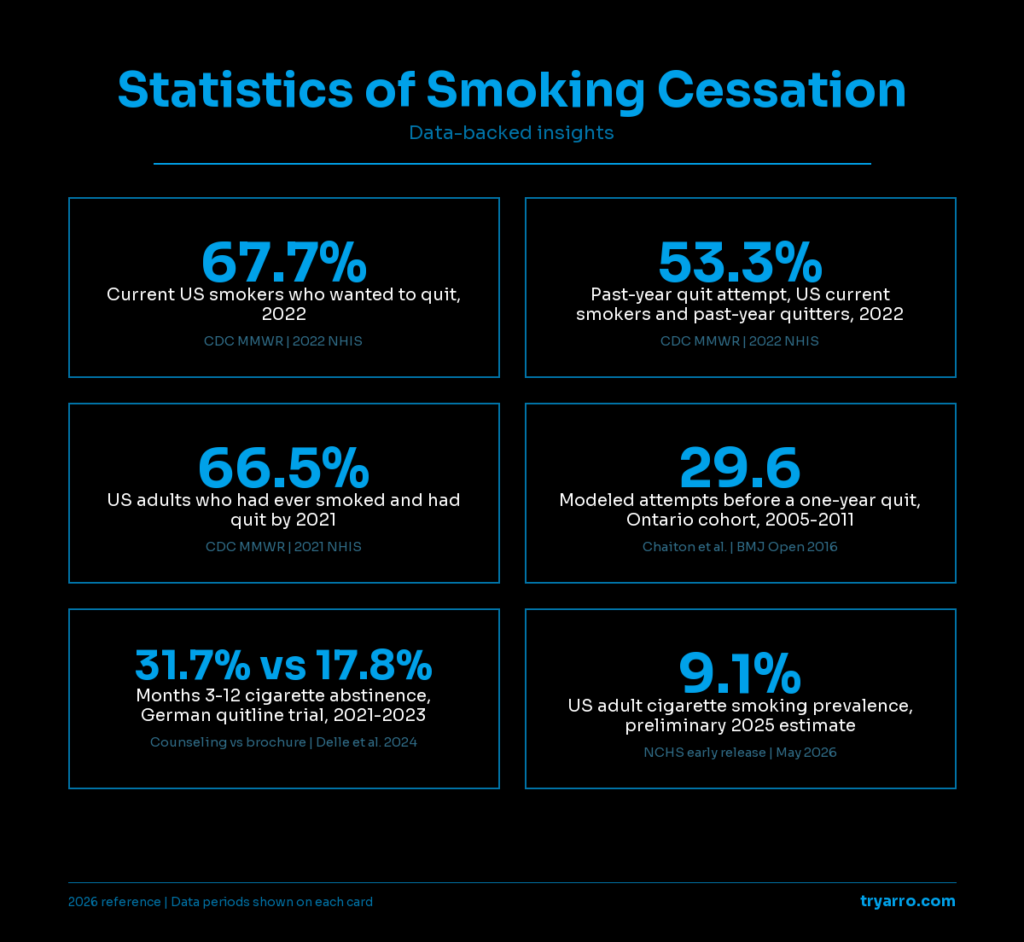
- 53.3% attempted quitting among US current smokers and prior-year quitters in 2022, reports CDC MMWR.
- 8.8% had quit for at least six months within the prior year among US adults currently smoking with at least two years’ smoking history and prior-year quitters in the 2022 analysis by CDC MMWR.
- 66.5% of US adults who had ever smoked were former smokers in 2021, according to CDC MMWR.
- 9.1% of US adults currently smoked cigarettes in preliminary 2025 estimates from NCHS.
- 15.4% versus 8.0% was the final 2024 adult smoking prevalence in nonmetropolitan and large central metropolitan counties, respectively, reports NCHS.
- 2.3 million adult Medicaid or CHIP beneficiaries received claims-recorded tobacco-use-disorder treatment in 2023, according to CMS.
- 31.7% versus 17.8% achieved prolonged cigarette abstinence during months three through twelve in a German counseling-versus-brochure trial conducted in 2021–2023, reports European Addiction Research.
- 29.6 attempts was one historical model’s estimate before at least a year of abstinence, based on Ontario interviews from 2005–2011, reports BMJ Open. It is not a required number for each person.
How many adults who smoke want to quit or make an attempt?
In the 2022 US adult survey, 67.7% wanted to quit and 53.3% attempted quitting, reports CDC MMWR. Interest covered current smokers; attempts included prior-year quitters.
An intention and an attempt answer different questions. A reader looking for practical next steps can use ARRØ’s guide to quitting nicotine alongside this numerical reference.
What percentage of adults recently quit smoking?
8.8% had quit for at least six months within the prior year among US adults currently smoking with at least two years’ smoking history and prior-year quitters in the 2022 analysis by CDC MMWR.
What percentage of people who ever smoked have quit?
66.5% were former smokers among US adults who had smoked at least 100 cigarettes in their lifetime, according to the 2021 NHIS analysis published by CDC MMWR in 2023.
This is the quit ratio. It compares former smokers with everyone who ever smoked, bringing together people with different smoking histories and different times since quitting. It cannot answer how likely a particular attempt is to succeed. Keep the survey year attached when using this historical figure.
An annual cessation percentage and a quit ratio can both be correct. They describe different groups and time windows, so comparing their size without the definitions can create a misleading impression.
How many attempts does it take to quit smoking?
29.6 expected attempts was the preferred model estimate before abstinence lasting at least a year in an Ontario study using interviews from 2005–2011, published in BMJ Open in 2016. The researchers analyzed adults who reported serious quit attempts and built a life-table model from their observations. The BMJ Open analysis placed its preferred estimate within a 95% interval of 27.6–31.6 attempts. Other assumptions produced different estimates. Successful quitting was self-reported.
The finding challenges the idea that everyone succeeds quickly. It does not predict an individual’s future or tell someone to expect repeated failure. It is a historical Canadian model, with a defined abstinence endpoint, rather than a current US average that applies to every person.
How many adults use counseling or medication when quitting?
In the 2022 US NHIS, 38.3% used counseling or medication among current smokers who attempted quitting in the prior year and adults who quit within two years, reports CDC MMWR.
How many Medicaid beneficiaries receive recorded tobacco treatment?
2.3 million adult beneficiaries, or 3.9%, received tobacco-use-disorder treatment in 2023 claims analyzed by CMS for its April 2026 report. The denominator includes adults with full Medicaid or CHIP benefits for at least a day that year. It is not restricted to people who smoked or tried to quit. CMS reported a treatment-receipt range of 2.1%–7.3% across included jurisdictions.
Claims record services billed within the program. These percentages cannot establish how many people wanted treatment, how many had unmet needs, or whether the treatment resulted in quitting. They describe documented service receipt in a defined insured population. Keeping that distinction visible prevents a low percentage from being mislabeled as a failure rate.
What have smoking cessation treatment trials found?
The odds ratio for weeks nine through twelve of continuous abstinence was 3.61 for varenicline versus placebo in the international EAGLES trial conducted in 2011–2015 and published in The Lancet in 2016. For that same endpoint, The Lancet study reported odds ratios versus placebo of 2.07 for bupropion and 2.15 for a nicotine patch. Every group received brief counseling. The trial enrolled motivated-to-quit smokers aged 18–75 across multiple countries.
Odds ratios compare odds, not the percentage of people who quit. They do not mean that a treatment made that many times as many people quit permanently. The follow-up window and accompanying counseling are part of the finding.
ARRØ’s nicotine patch reviews article offers separate reader-oriented context. Consumer experiences and product discussions should not be substituted for a randomized trial’s treatment comparison.
What did a telephone counseling trial report?
31.7% achieved prolonged cigarette abstinence versus 17.8% receiving a brochure in a German quitline trial conducted from October 2021 to November 2023, published in European Addiction Research in 2024. The outcome covered months three through twelve and was assessed at month twelve. The analysis counted participants according to their randomized group. A separate prolonged tobacco-abstinence endpoint in European Addiction Research was 30.8% versus 15.2%.
These outcomes belong to this trial’s participants, comparison, and follow-up period. They are not national quit rates. The distinction between cigarette abstinence and tobacco abstinence matters, too. A change in the outcome being measured can change what a success percentage means.
How did a trial measure quitting nicotine vaping?
40.0% versus 20.0% achieved continuous vaping abstinence during weeks four through twelve with varenicline plus counseling versus placebo plus counseling in an Italian trial of adult daily nicotine e-cigarette users conducted in 2018–2020, published in BMC Medicine in 2023. Participants wanted to quit. Zero-nicotine product users were excluded. At the longer weeks-four-through-twenty-four endpoint, BMC Medicine reported abstinence of 34.3% versus 17.2%.
This was a study of quitting nicotine vaping. Its percentages cannot be relabeled as smoking cessation results or used to establish that a nicotine-free consumer product helps people stop smoking. A discussion of breaking the hand-to-mouth habit addresses a different subject from the clinical outcomes measured here.
What do the newest US smoking figures show?
9.1% of US adults currently smoked cigarettes in preliminary January–December 2025 estimates released by NCHS in May 2026.
The release preceded final editing and final weighting. That status belongs beside the number when it is compared with a final annual estimate. Current-smoking prevalence describes how common smoking is across the adult population. It does not isolate successful quit attempts or identify why the population percentage changed.
How did final smoking prevalence differ by county type?
15.4% in nonmetropolitan counties and 8.0% in large central metropolitan counties currently smoked in the final 2024 US adult estimates published by NCHS in March 2026. The final 2024 national estimate from NCHS was 9.9%. These geographic percentages describe smoking prevalence within each county group, not cessation success. A geographic difference alone does not establish its cause. Use this comparison to describe the population picture, keeping it separate from a trial’s abstinence outcome or a survey’s attempt rate.
ARRØ and the adult nicotine-free ritual
ARRØ is for adults 21 and older who already use or recently used nicotine. Its nicotine-free collection reflects the brand’s focus on the ritual. ARRØ is not NRT or a smoking-cessation device, and the clinical findings above do not establish its effectiveness for quitting.
Sources
- CDC MMWR, 2022 adult smoking cessation survey, published 2024.
- NCHS, preliminary 2025 NHIS estimates, released May 2026.
- NCHS, final 2024 smoking prevalence, E-Stat 115, published March 2026.
- CMS, adult tobacco treatment in 2023 claims, released April 2026.
- The Lancet, EAGLES trial conducted 2011-2015, published 2016, investigator manuscript.
- European Addiction Research, German quitline trial conducted 2021-2023, published 2024.
- BMC Medicine, nicotine vaping cessation trial conducted 2018-2020, published 2023.
- BMJ Open, Ontario quit-attempt model using 2005-2011 interviews, published 2016.
- CDC MMWR, 2021 NHIS tobacco use and quit ratio, published 2023.
 Cessation Cravings: