



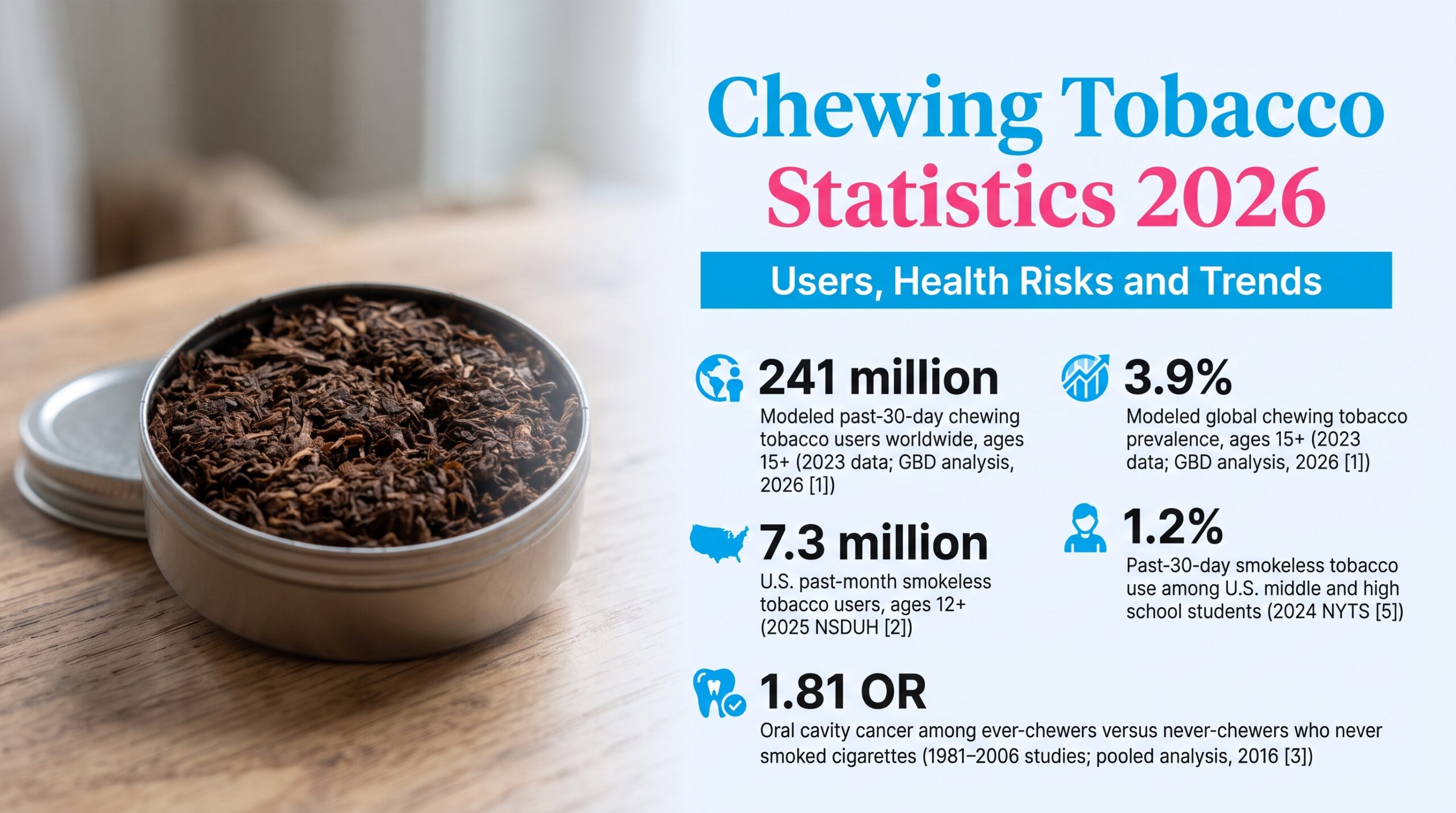
A global model estimated that 241 million people ages 15 and older used chewing tobacco worldwide in 2023. If you’re looking for a U.S. number, check the label on the figure first. The 2025 National Survey on Drug Use and Health counted snuff, dip, chewing tobacco and snus together. Its totals tell us how common the broader category is and leave the number of people who specifically use chew unresolved. [1] [2]
Key Takeaways
- The 2026 Global Burden of Disease analysis estimated that 3.9% of people ages 15 and older worldwide used chewing tobacco in the past 30 days in 2023. The 95% uncertainty interval was 2.7% to 5.8%. [1]
- About 7.3 million U.S. residents ages 12 and older used some form of smokeless tobacco in the past month in 2025. The total includes dip, snuff and snus as well as chew. [2]
- A pooled analysis of U.S. chewing tobacco and oral cancer studies found higher odds of oral cavity cancer among people who had chewed tobacco and had never smoked cigarettes. Its estimate applies to the people and exposure studied. [3]
Chewing Tobacco Statistics Summary
The figures below answer different questions. Use the product definition and time window to decide which figure fits the comparison you want to make.
| Statistic | What it measures | Year + source |
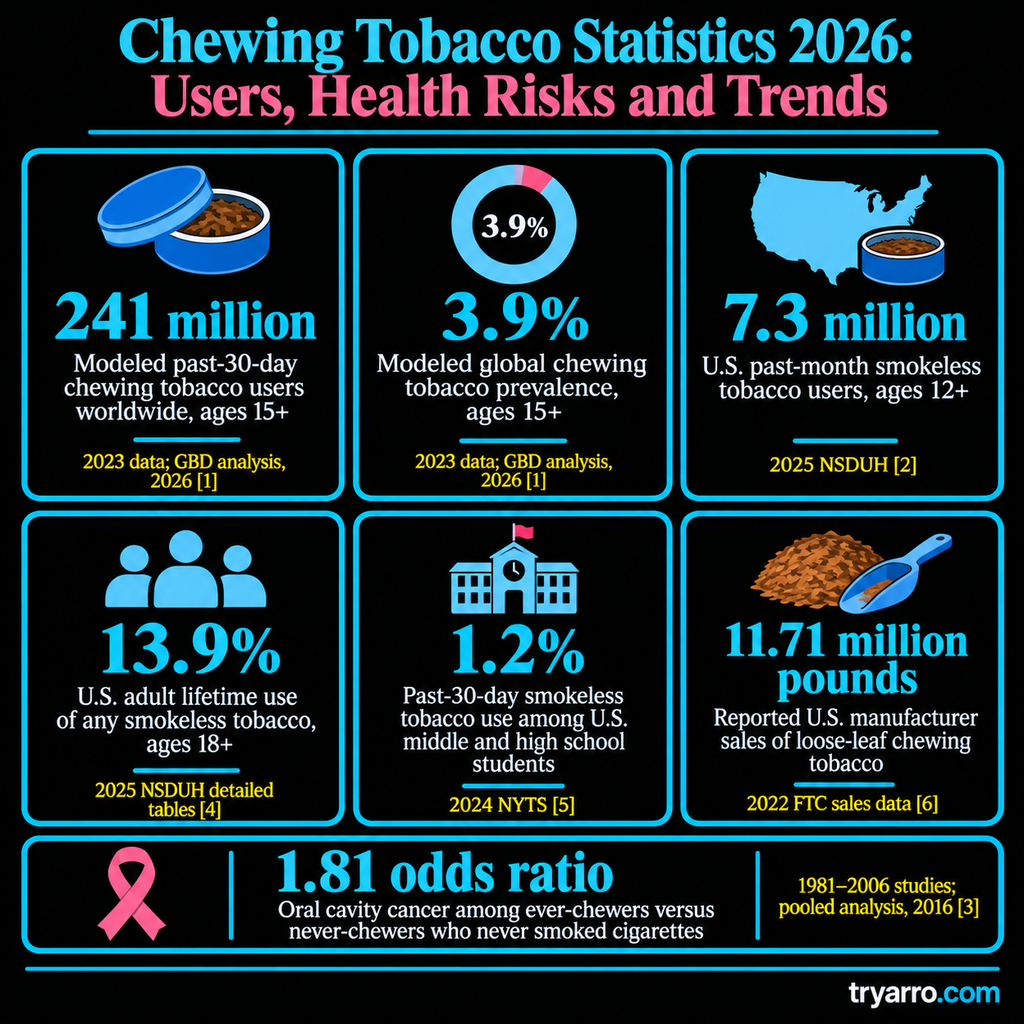
| 241 million | Modeled past-30-day chewing tobacco users worldwide, ages 15+ | 2023 data; GBD analysis, 2026 [1] |
| 3.9% | Modeled global chewing tobacco prevalence, ages 15+ | 2023 data; GBD analysis, 2026 [1] |
| 7.3 million | U.S. past-month smokeless tobacco users, ages 12+ | 2025 NSDUH [2] |
| 13.9% | U.S. adult lifetime use of any smokeless tobacco, ages 18+ | 2025 NSDUH detailed tables [4] |
| 1.2% | Past-30-day smokeless tobacco use among U.S. middle and high school students | 2024 NYTS [5] |
| 11.71 million pounds | Reported U.S. manufacturer sales of loose-leaf chewing tobacco | 2022 FTC sales data [6] |
| 1.81 odds ratio | Oral cavity cancer among ever-chewers versus never-chewers who never smoked cigarettes | 1981–2006 studies; pooled analysis, 2016 [3] |
Worldwide Chewing Tobacco Use
The Global Burden of Disease 2023 study estimated 241 million users of chewing tobacco worldwide in 2023, with a 95% uncertainty interval of 165 million to 355 million. The researchers defined current use as daily or occasional use of a chewed tobacco product in the previous 30 days. Their category covers a range of chewed products, including forms used outside the U.S. [1]
The Global Burden of Disease researchers combined surveys that asked about individual products with information from surveys that grouped smokeless products together. They used a statistical model to estimate chewing tobacco use by place, age, sex and year. The wide interval is a reason to report the range alongside the headline figure, especially when comparing it with an estimate from a different edition of the study. [1]
Regions With the Highest Chewing Tobacco Use
South Asia had the highest estimated prevalence among the broad regions in the 2023 Global Burden of Disease regional estimates. An estimated 14.6% of people ages 15 and older in the region used chewing tobacco, with a 95% uncertainty interval of 10.2% to 20.9%. These regional figures include products that can differ in ingredients and preparation from the loose-leaf chew sold in the U.S. [1]
Global Chewing Tobacco Trends
The Global Burden of Disease analysis of change since 1990 estimated an increase of 90.7 million users from 1990 to 2023, with a 95% uncertainty interval spanning a decrease of 26.7 million to an increase of 220 million. The model leaves the direction of the global change uncertain. Also, the number of users can rise as a population grows, even if the share of people who use a product falls. [1]
Smokeless Tobacco Use in the United States
Among U.S. adults ages 18 and older, 2.7% reported past-month use and 13.9% reported lifetime use of smokeless tobacco in 2025. The survey represents the civilian, noninstitutionalized population. Past-month use captures recent use, including occasional use. Lifetime use includes people who tried a product and may have stopped years ago. [4]
The broader 2025 household survey estimate of about 7.3 million past-month users starts at age 12. You’ll see both figures reported, so check the age range before using a percentage and a headcount in the same sentence. The national tables group chew, snuff, dip and snus, which leaves each product’s share unresolved. [2]
For broader context across products, ARRØ’s nicotine statistics on use, dependence and product trends explains how national surveys distinguish tobacco use from nicotine vaping. These measures can help place smokeless tobacco in the wider picture, provided the age range and survey definition stay attached to each figure.
Smokeless Tobacco Use Among U.S. Students
In the 2024 National Youth Tobacco Survey, 1.2% of U.S. public and private middle and high school students reported using smokeless tobacco on at least one day in the past 30 days. The estimate was 1.5% among high school students and 0.8% among middle school students. [5]
That survey recorded nicotine pouches separately, with 1.8% of students reporting past-30-day pouch use. Those results come from separate survey questions, so they cannot tell us how many students moved from chew to pouches. The same student could report use of both. It also reached students through schools, while the national household survey defines its population by age. If you’re comparing youth and adult use, look for estimates from the same survey or state the difference in coverage. [5]
U.S. Chewing Tobacco Sales Trends
U.S. reporting manufacturers sold 13.79 million pounds in 2021 and 11.71 million pounds in 2022 of loose-leaf chewing tobacco, according to the Federal Trade Commission. That’s a decline of about 15.0% in reported pounds over one year. The table tracks manufacturer sales to wholesalers and retailers. It reports plug and twist chewing tobacco in a separate table. [6]
Sales show how much product moved through that part of the market. They leave several questions open, including how often people bought chew, whether they bought smaller quantities or whether they changed products. The adult household surveys add a different piece of evidence. The 2025 detailed tables give recent smokeless tobacco use as 2.5% in 2024 and 2.7% in 2025 among adults ages 18 and older, with no statistically significant difference between the two years. [4]
You can use the sales figures to say that reported loose-leaf volume fell over this period. To say the number of people who use chew fell, you would need a survey that measured chew separately in both years. A different product mix inside the household survey’s smokeless category could leave its overall estimate steady even as use of one product changed.
Health Risks of Chewing Tobacco
Chewing tobacco exposes the mouth to nicotine and carcinogens. The International Agency for Research on Cancer evaluated the evidence for smokeless tobacco, including chew and snuff. The National Cancer Institute identifies cancers of the mouth, esophagus and pancreas as consequences of smokeless tobacco use. The agency also notes nicotine dependence, gum disease and oral lesions among the concerns. [7] [8]
U.S. Research on Oral Cancer
In a 2016 analysis of 11 U.S. case-control studies, people who had ever chewed tobacco and had never smoked cigarettes had 1.81 times the odds of oral cavity cancer compared with people who had never chewed tobacco and had never smoked cigarettes. The 95% confidence interval was 1.04 to 3.17. The underlying studies ran from 1981 to 2006. [3]
For head and neck cancers combined in the same analysis, the odds ratio was 1.20, with a 95% confidence interval of 0.81 to 1.77. That interval includes 1, the value that would indicate equal odds. The wider cancer grouping and the oral cavity result describe different outcomes. Both are adjusted estimates from a case-control comparison. The oral cavity estimate was based on a small exposed group of 23 cases and 96 controls among people who had never smoked cigarettes. To estimate someone’s absolute chance of developing cancer, you would need additional information about their underlying risk. [3]
Differences Between Chew, Dip, Snus and Nicotine Pouches
According to the National Cancer Institute’s smokeless tobacco definitions, chewing tobacco comes in forms such as loose leaf, plug and twist. Dip typically refers to moist snuff, which uses finely cut tobacco. Snus is a moist oral tobacco product, often sold in pouches. Product names can overlap in conversation, so use the study’s own wording when you cite a statistic. [8]
The National Youth Tobacco Survey treats nicotine pouches as a separate category from chewing tobacco, snuff, dip and snus. The survey defines nicotine pouches as products containing nicotine without tobacco leaf. The pouch format alone cannot tell you which category a product belongs to. If you’re comparing what different products involve day to day, ARRØ’s guide to nicotine pouches and vaping explains the distinction between placing a pouch in the mouth and using an inhaled product. [5]
Support for Quitting Chewing Tobacco
The National Cancer Institute’s smokeless tobacco resources offer a starting point if you’re thinking about quitting, and a clinician or quitline can help you decide what to try. It can help to describe what you use, how often you use it, and when you find yourself reaching for it. [8]
ARRØ’s smoking cessation statistics on quit attempts and sustained abstinence explains how quitting outcomes are measured. Those figures concern cigarette smoking and should not be reused as success rates for people quitting chewing tobacco. The distinction is useful when comparing support research across different tobacco products.
Chewing Tobacco Statistics FAQs
Is there a U.S. count for people who use only chewing tobacco?
The 2025 national household survey gives a combined count for smokeless tobacco. The published figure can include people using snuff, dip or snus, so it cannot answer how many people used chewing tobacco alone. [2]
Does past-30-day use mean daily use?
No. For the 2024 school survey, current use meant use on at least one day in the previous 30 days. Someone who used a product once in that window and someone who used it every day both count toward that measure. [5]
What does the oral cancer odds ratio tell you?
The U.S. pooled analysis of chewing tobacco and oral cancer compares the odds of cancer between exposure groups. Its oral cavity estimate of 1.81 among people who never smoked cigarettes is a relative association, not an 81% probability of developing cancer. Estimating absolute risk requires additional information about the population and follow-up period. [3]
References and Sources
- GBD 2023 Chewing Tobacco Collaborators. “Global, Regional, and National Burden of Exposure to Chewing Tobacco, 1990–2023: A Systematic Analysis of the Global Burden of Disease Study 2023.” The Lancet Global Health, 2026.
- SAMHSA, 2025 National Survey on Drug Use and Health: Annual National Report
- “Smokeless Tobacco Use and the Risk of Head and Neck Cancer: Pooled Analysis of US Studies in the INHANCE Consortium.” American Journal of Epidemiology, 2016.
- SAMHSA, 2025 National Survey on Drug Use and Health: Detailed Tables
- CDC, Tobacco Product Use Among Middle and High School Students, 2024
- Federal Trade Commission, 2022 Smokeless Tobacco Report
- International Agency for Research on Cancer, Smokeless Tobacco and Some Tobacco-specific N-Nitrosamines
- National Cancer Institute, Smokeless Tobacco and Cancer
 Cessation Cravings: