
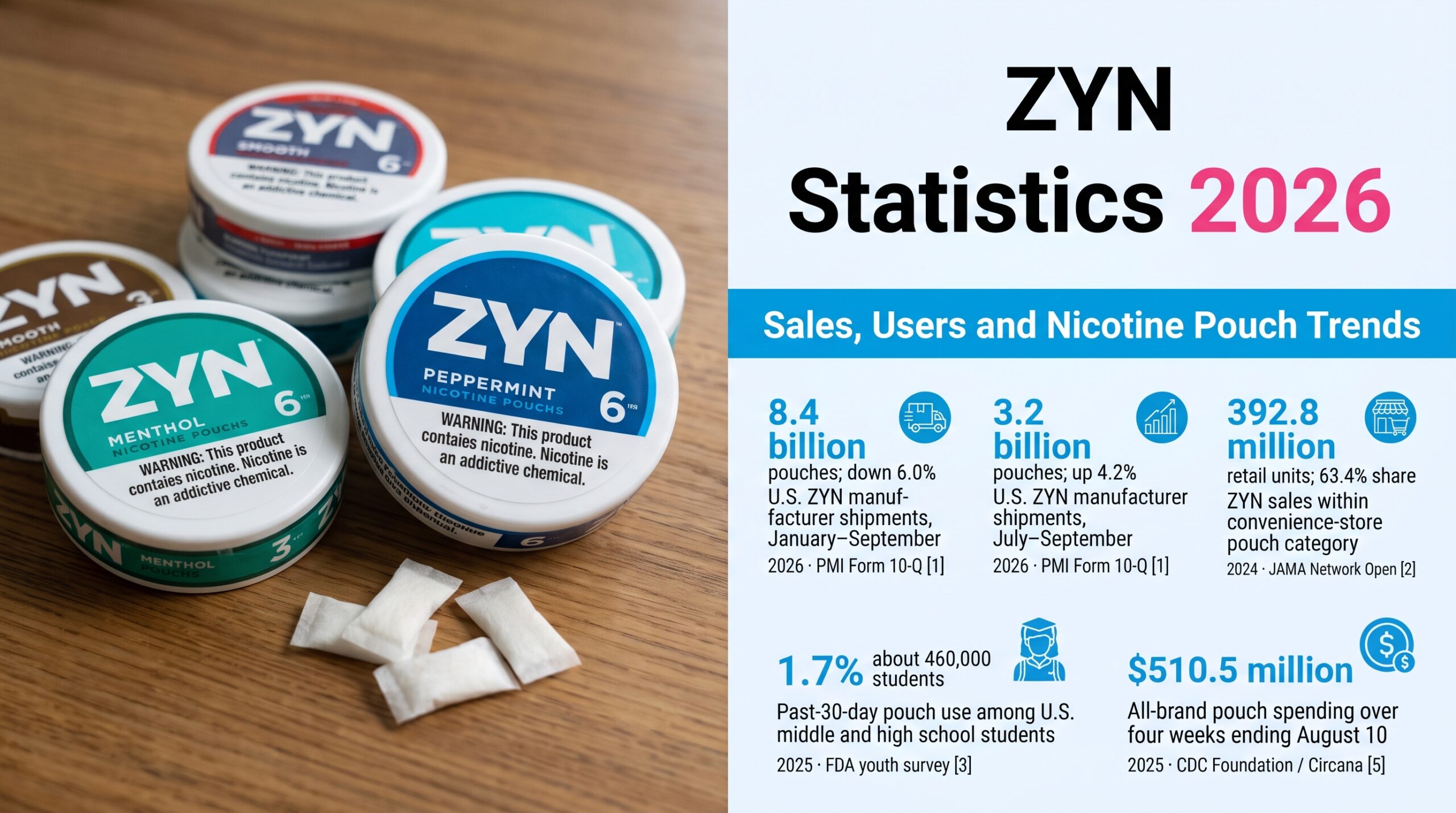
Philip Morris International (PMI) reported 8.4 billion ZYN pouches shipped in the United States [1] from January through September 2026. That figure measures individual pouches shipped by the manufacturer. To see what people bought, look to retail scanner data. To see what people used, look to surveys. Each answers a different question, with different reporting periods. The full-year convenience-store series in this article ends in 2024.
Key Takeaways on ZYN Sales and Use
- PMI reported 8.4 billion U.S. ZYN pouches shipped [1] in the first nine months of 2026, down 6.0% from the same period in 2025.
- In U.S. convenience stores in 2024, ZYN accounted for 63.4% of nicotine pouch retail units [2], with 392.8 million ZYN units out of 619.6 million all-brand units.
- In the 2025 National Youth Tobacco Survey, 1.7% of U.S. middle and high school students reported current nicotine pouch use [3], and 69.2% of those current users reported ZYN.
ZYN and Nicotine Pouch Statistics Summary
These figures separate manufacturer shipments, retail sales and reported use. The year and population differ across sources, so each measure retains its original scope.
| Statistic | What it measures | Year + source |
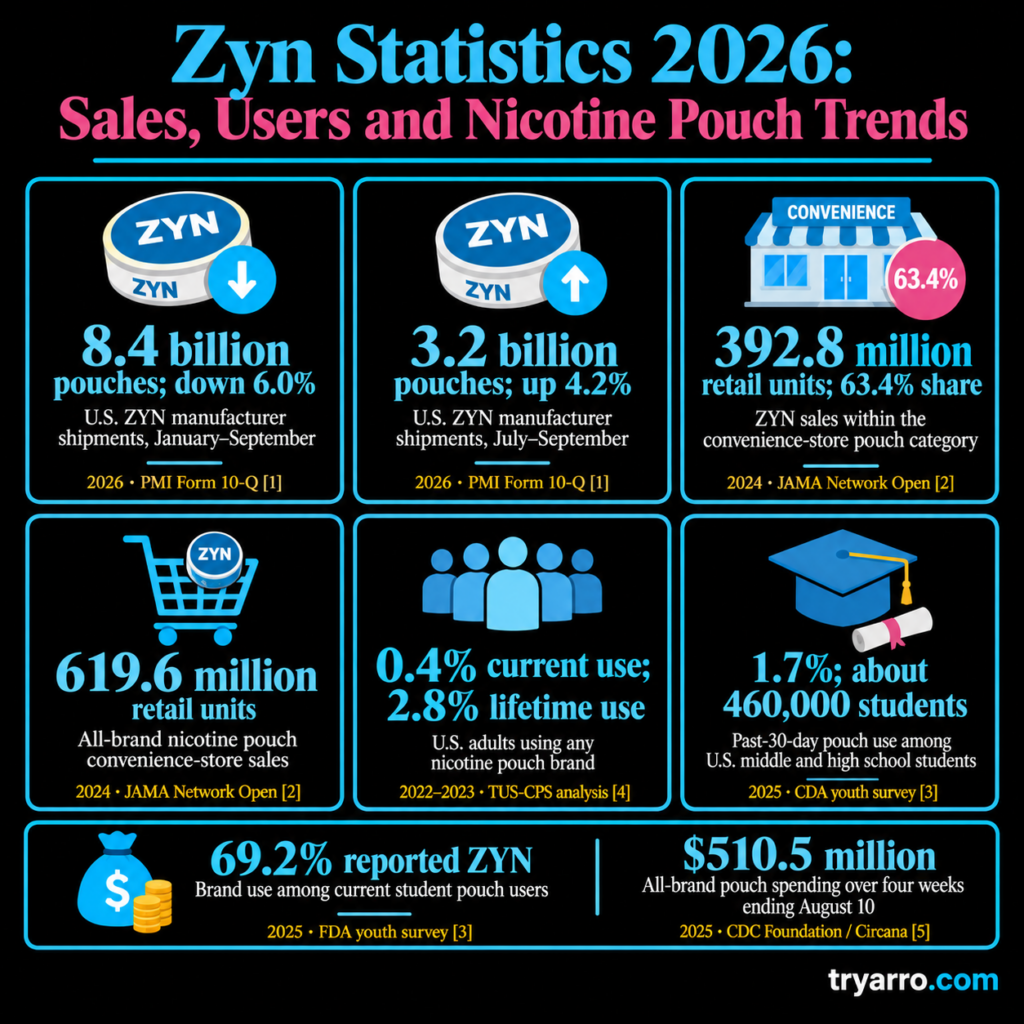
| 8.4 billion pouches; down 6.0% | U.S. ZYN manufacturer shipments, January–September | 2026 · PMI Form 10-Q [1] |
| 3.2 billion pouches; up 4.2% | U.S. ZYN manufacturer shipments, July–September | 2026 · PMI Form 10-Q [1] |
| 392.8 million retail units; 63.4% share | ZYN sales within the convenience-store pouch category | 2024 · JAMA Network Open [2] |
| 619.6 million retail units | All-brand nicotine pouch convenience-store sales | 2024 · JAMA Network Open [2] |
| 0.4% current use; 2.8% lifetime use | U.S. adults using any nicotine pouch brand | 2022–2023 · TUS-CPS analysis [4] |
| 1.7%; about 460,000 students | Past-30-day pouch use among U.S. middle and high school students | 2025 · FDA youth survey [3] |
| 69.2% reported ZYN | Brand use among current student pouch users | 2025 · FDA youth survey [3] |
| $510.5 million | All-brand pouch spending over four weeks ending August 10 | 2025 · CDC Foundation / Circana [5] |
U.S. ZYN Shipments in 2026
Third-Quarter Growth and the Nine-Month Decline
PMI reported that U.S. ZYN shipments rose 4.2% year over year to 3.2 billion pouches in July–September 2026 [1]. Across January–September, shipment volume fell 6.0% to 8.4 billion pouches [1]. The quarter and the nine-month period can move in opposite directions because the third quarter is only one part of the year. The filing discusses distributor and trade inventory movements in the first quarter [1], a reason to avoid interpreting shipment changes as identical changes in purchases.
Shipment Units and Retail Revenue
PMI reports the brand figures as individual ZYN pouches shipped by the manufacturer [1]. Retail scanners track packaged units sold through the retailers in their dataset, so a shipment count and a retail-unit count cannot be treated as interchangeable. The convenience-store analysis of nicotine pouch sales [2] provides a separate measure of purchases within that channel. A brand revenue figure would require a source identifying the relevant period, sales channel and dollar measure.
U.S. Retail Sales of ZYN and Other Nicotine Pouches
Brand Sales and Category Sales in Convenience Stores
U.S. convenience-store scanner data show 619.6 million nicotine pouch retail units sold in 2024 [2], up from 437.0 million in 2023 [2]. The 2025 analysis used Nielsen data that identified products and brands from their UPCs. In the same channel, ZYN sales increased from 282.7 million retail units in 2023 to 392.8 million in 2024 [2].
ZYN’s share of nicotine pouch retail units moved from 64.7% in 2023 to 63.4% in 2024 [2]. Brand volume grew, and its share fell as the category grew faster. The common time periods and sales channel make the comparison possible. The figures cover convenience stores in the study and should stay attached to that channel when cited.
Hrywna and colleagues’ retail sales table [2] tracks annual packaged units. Other brands accounted for 154.3 million units in 2023 and 226.8 million in 2024, calculated by subtracting ZYN units from the category total.
Nicotine Pouches Within the Broader Oral Market
In 2024, nicotine pouches accounted for 43.7% of oral tobacco and nicotine units sold [2] in the same U.S. convenience-store data. That denominator includes products such as moist snuff and snus alongside nicotine pouches. The 63.4% figure answers a narrower question about ZYN’s share within the pouch category. Both percentages describe units sold. Counting unique customers would require data that can identify buyers across transactions.
Retail Dollar Sales Across Brands
The CDC Foundation’s analysis of Circana point-of-sale data found that U.S. nicotine pouch retail spending across brands rose from $145.5 million in the four weeks ending January 29, 2023 [5] to $510.5 million in the four weeks ending August 10, 2025 [5], an increase of 250.8%. The data cover tracked multi-outlet and convenience retailers and exclude online retailers and vape shops.
Dollar sales measure what went through the till. They can rise when shoppers buy more packages, pay more per package or buy a different mix of products. Dividing retail dollars by an assumed price or applying a brand’s unit share from another dataset would introduce assumptions about the channel, period and product mix.
Nicotine Pouch Use Among U.S. Adults
Current Use and Lifetime Use
An analysis of the 2022–2023 Tobacco Use Supplement to the Current Population Survey found 0.4% current nicotine pouch use [4] among U.S. adults, compared with 2.8% lifetime use [4]. The study’s weighted estimates [4] use responses from 114,206 U.S. adults who answered for themselves. The analysis was published in 2026. Current use meant that respondents said they used nicotine pouches every day or on some days. Lifetime use includes adults who had tried a pouch even once. The estimates cover all nicotine pouch brands.
ZYN Use Among Adults Who Used Pouches Recently
Among U.S. adults who reported past-30-day nicotine pouch use in the May 2023 survey wave, 45.7% named ZYN as their most-used brand [4]. The survey allowed one answer for that question. The estimate comes from a subgroup and had a 95% confidence interval of 35.6% to 56.2% [4]. The share who named ZYN was 41.7% in September 2022 and 52.6% in January 2023 [4]. The analysis did not find a statistically significant difference across the three waves for this measure, so the point estimates alone give limited evidence of a trend. The survey figures presented here do not give a 2026 total of U.S. adults who use ZYN or a count of people who bought it.
For the wider pattern across products and age groups, see ARRØ’s U.S. nicotine statistics by product and age. Those comparisons help place pouch use alongside other forms of nicotine use.
Nicotine Pouch Use Among U.S. Students
Past-30-Day Use and ZYN Brand Reporting
In the 2025 National Youth Tobacco Survey, 1.7% of U.S. middle and high school students reported current nicotine pouch use [3], representing an estimated 460,000 students. The FDA published the results in June 2026 and defined current use as use on one or more days in the preceding 30 days.
Among students who reported current pouch use, 69.2% reported ZYN [3]. The 69.2% uses current pouch users as its denominator. The 1.7% uses the full student population represented by the survey. The FDA described current pouch use as stable from 2024 to 2025 [3]. These school survey figures describe self-reported behavior and provide no measure of youth purchasing.
Frequency of Student Pouch Use
Among current U.S. student pouch users in 2025, 17.6% reported daily use [3] and 26.3% reported use on at least 20 of the previous 30 days [3]. Daily use is part of the 20-or-more-days group, so adding the percentages would count some students twice. One more measure answers a different question. In the same group, 90.8% reported using flavored pouches [3]. All three rates apply to current pouch users within the surveyed student population.
Frequently Asked Questions About ZYN Statistics
How much ZYN did PMI ship in 2026?
PMI reported 8.4 billion individual ZYN pouches shipped in the United States [1] from January through September 2026, down 6.0% year over year. This is a nine-month manufacturer shipment figure. The measures in this article do not establish ZYN’s full-year 2026 retail revenue.
How much did shoppers spend on nicotine pouches?
Across tracked U.S. multi-outlet and convenience retailers, shoppers spent $510.5 million on nicotine pouches of all brands [5] in the four weeks ending August 10, 2025. The total describes the pouch category in the measured stores. It gives no separate dollar figure for ZYN.
What share of nicotine pouch sales was ZYN?
ZYN represented 63.4% of nicotine pouch retail units [2] in the Nielsen data analyzed for U.S. convenience stores in 2024. That was 392.8 million ZYN units out of 619.6 million all-brand pouch units in that channel. The share measures sales by unit and applies to the stores and period in the study.
How many people use ZYN?
The cited sources do not establish a current total for U.S. ZYN users. The 2022–2023 adult survey [4] estimates use of the broader pouch category and measures most-used brands among a subset. The 2025 youth survey [3] reports ZYN use among students who already reported current pouch use.
Is buying nicotine pouches the same as using them?
Buying and using pouches are separate measures. Convenience-store retail scanner data on nicotine pouch sales [2] count units sold, so several units could come from one buyer. The national adult survey of nicotine pouch use [4] measures what respondents say they used, regardless of who paid for the product. Neither measure tracks a person’s purchase and use together.
References and Sources
- Philip Morris International Inc. “Form 10-Q for the Quarter Ended September 30, 2026.” U.S. Securities and Exchange Commission, 2026.
- Hrywna, Mary, et al. “Oral Tobacco and Nicotine Marketplace Trends Since the Tobacco Control Act.” JAMA Network Open, 30 Oct. 2025.
- U.S. Food and Drug Administration. “Results from the Annual National Youth Tobacco Survey.” 2025 findings, June 2026.
- Tashakkori, Nicole A., et al. “Nicotine Pouch Use and Associated Characteristics Among U.S. Adults.” PLOS One, 2026.
- CDC Foundation. “Nicotine Pouch Sales Data Brief.” Tobacco Monitoring, Oct. 2025.
 Cessation Cravings: