



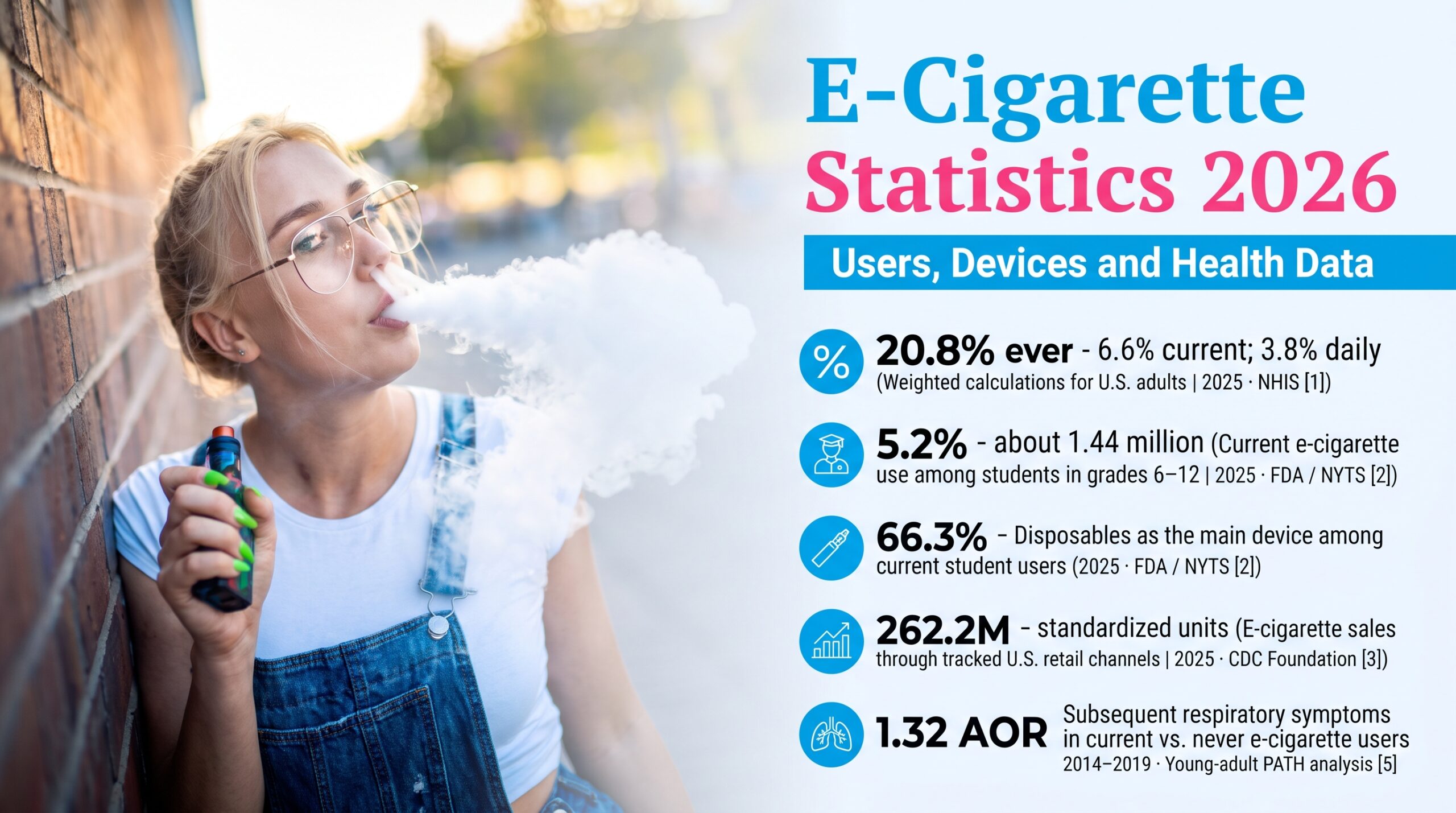
In 2025, an estimated 6.6% of U.S. adults used e-cigarettes every day or some days, based on a weighted analysis of the final adult NHIS file [1]. In a separate school survey, 5.2% of middle and high school students [2] reported using e-cigarettes on at least one of the previous 30 days.
Both are measures of current use in their respective surveys. The wording matters when comparing estimates. So does the difference between a person who reports using a device, a retail package sold, and a patient who reports a symptom.
Key Takeaways on E-Cigarette Statistics
- Weighted estimates from the 2025 adult NHIS [1] put lifetime e-cigarette use at 20.8%, current use at 6.6%, and daily use at 3.8% among U.S. adults with valid responses.
- Among U.S. middle and high school students who reported past-30-day use [2] in 2025, 27.5% said they used e-cigarettes on all 30 days.
- In 2025, tracked U.S. e-cigarette retail sales [3] included 262.2 million standardized units, a package-based measure that excludes online retailers and vape shops.
- The PATH studies on urinary markers of nicotine and toxicant exposure [4] and respiratory symptoms among young adult e-cigarette users [5] measured different things, so a biomarker difference cannot be read as a difference in disease incidence.
U.S. E-Cigarette Statistics Summary
The figures use different denominators. Read the population or retail unit alongside the estimate before quoting it.
| Statistic | What it measures | Year + source |
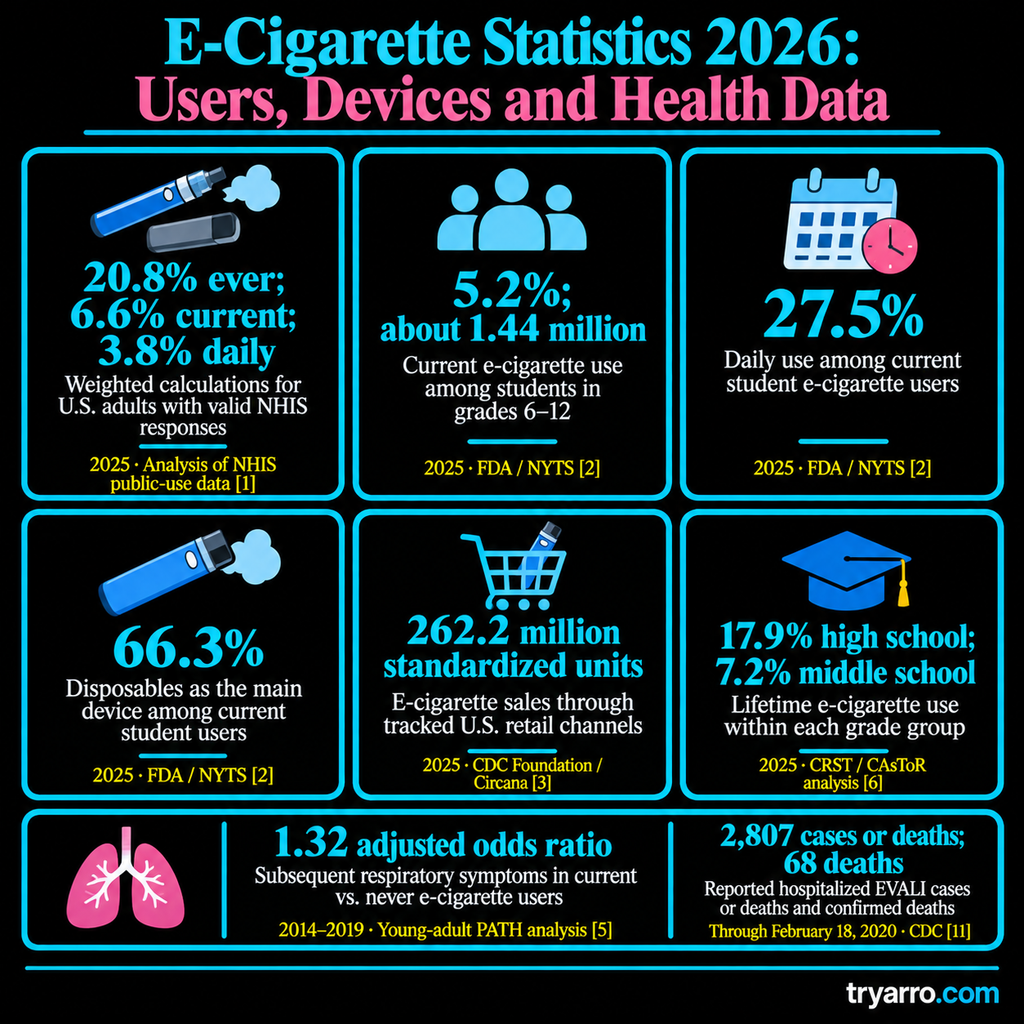
| 20.8% ever; 6.6% current; 3.8% daily | Weighted calculations for U.S. adults with valid NHIS responses | 2025 · Analysis of NHIS public-use data [1] |
| 5.2%; about 1.44 million | Current e-cigarette use among students in grades 6–12 | 2025 · FDA / NYTS [2] |
| 27.5% | Daily use among current student e-cigarette users | 2025 · FDA / NYTS [2] |
| 66.3% | Disposables as the main device among current student users | 2025 · FDA / NYTS [2] |
| 262.2 million standardized units | E-cigarette sales through tracked U.S. retail channels | 2025 · CDC Foundation / Circana [3] |
| 17.9% high school; 7.2% middle school | Lifetime e-cigarette use within each grade group | 2025 · CRST / CAsToR analysis [6] |
| 1.32 adjusted odds ratio | Subsequent respiratory symptoms in current vs. never e-cigarette users | 2014–2019 · Young-adult PATH analysis [5] |
| 2,807 cases or deaths; 68 deaths | Reported hospitalized EVALI cases or deaths and confirmed deaths | Through February 18, 2020 · CDC [11] |
E-Cigarette Use Among U.S. Adults
About one in five U.S. adults reported having tried an e-cigarette or other electronic vaping product in the 2025 National Health Interview Survey adult data [1], while about one in fifteen reported current use. The household survey represents civilian, noninstitutionalized adults aged 18 and older.
Ever, Current and Daily Use
The three NHIS measures of adult e-cigarette use [1] answer different questions. Ever use includes trying a product even once. Current use requires lifetime use plus a report of using every day or some days at the interview. Daily use is the narrower every-day response. Someone who tried a device once years ago can count as an ever user and be outside both other groups.
A weighted analysis of the final 2025 NHIS Sample Adult public-use data [1] calculated 20.8% ever use, 6.6% current use and 3.8% daily use for this page. Ever use includes adults with a valid lifetime response; current and daily use include adults who reported never using or who reported ever using and answered the frequency question. These are calculated point estimates, rather than a separately published NCHS table, and are subject to sampling and self-report error.
Changes Over Time and by Age
In the 2019–2023 NHIS series on adult e-cigarette use [7], current adult use fell from 4.5% in 2019 to 3.7% in 2020, then climbed to 6.5% in 2023. Looking only at the first and last years would hide the earlier dip.
In the 2024 NHIS estimates of e-cigarette use by age [8], 14.8% of adults aged 18–24 reported current use, compared with 11.1% of those aged 25–44, 4.1% of those aged 45–64, and 1.0% of those aged 65 and older. These are different age groups surveyed in the same year. They cannot show how use changed as the same people aged.
E-Cigarette Use Among U.S. Students
In 2025, the National Youth Tobacco Survey [2] estimated that about 1.44 million U.S. students in grades 6–12 used e-cigarettes in the previous 30 days. The school-based survey represents students in the grades covered rather than everyone within a particular age range.
Lifetime Use and Past-30-Day Use
An CRST and CAsToR analysis of lifetime student e-cigarette use [6] from the 2025 NYTS found that 17.9% of high school students and 7.2% of middle school students had ever tried e-cigarettes. The FDA’s past-30-day estimates [2] for the same survey were 7.1% for high school students and 2.6% for middle school students. Each percentage uses students in the relevant grade group as its denominator.
The gap between lifetime and recent use shows how much the measure changes when the time window narrows. It cannot tell us why a particular student stopped, whether they tried a product just once, or how long they had used it before the survey.
Changes in Past-30-Day Use
The four-year NYTS analysis of current student e-cigarette use [9] found that past-30-day use among middle and high school students declined from 9.4% in 2022 to 5.2% in 2025. The difference between 5.9% in 2024 and 5.2% in 2025 did not reach statistical significance on its own. The survey samples different students each year.
Daily and Frequent Use Among Current Users
Among students who used e-cigarettes in the past month, 27.5% reported daily use [2] and 41.2% reported using on at least 20 of the previous 30 days. Daily users are already included in that 20-or-more-days group. Both figures apply to current users.
E-Cigarette Device Types and Retail Sales
Disposables were the leading device category in both the 2025 national student e-cigarette survey [2] and the CDC Foundation’s tracked e-cigarette retail data [3]. To interpret either share, check whether the source counted people, purchases or standardized packages.
Disposables, Pods and Refillable Tanks
The CDC’s overview of e-cigarette device types [10] distinguishes products by how they hold and replace liquid. Disposables contain liquid in a unit intended to be discarded when finished. Pod systems use a separate pod or cartridge, which can be prefilled or refillable. Open tank systems use a reservoir that the user refills with bottled liquid.
In the 2025 student survey, 66.3% of current users reported disposables as their main type [2], and 12.0% reported using prefilled or refillable pods or cartridges most often. The question was about the device used most often. It leaves room for students to have used other formats.
Retail Units and the Limits of Market Coverage
Covered U.S. retail channels sold an estimated 262.2 million standardized retail units [3] in 2025, down from 291.1 million in 2024. The 2025 total included 158.3 million disposable units and 103.7 million standardized prefilled-cartridge units. The total also includes bottled e-liquid.
In the CDC Foundation’s scanner-data methodology [3], one unit represents one disposable device, five prefilled cartridges or one bottle of e-liquid. One person can buy repeatedly, and a purchase may include multiple units. The estimates omit vape shops and online retailers and exclude accessories and hardware sold without e-liquid. They describe covered retail activity.
ARRØ’s nicotine statistics by age and product provide additional context for comparing nicotine use across formats. Retail figures in this section describe purchases in covered stores, while the survey figures describe what people reported using.
Health Outcomes and Exposure Measurements
Health outcomes record what happened to people, such as wheezing or hospitalization. Exposure measurements record what was detected in emissions or in a sample from the body. Each informs a different part of the health question.
Aerosol and Urinary Exposure Markers
An aerosol measurement starts with the device and asks what it emitted under test conditions. The CDC’s explanation of e-cigarette aerosol [10] describes small airborne particles that a person can inhale. A biomarker measurement starts with a person and asks what can be detected in a sample, such as urine. The measurements have different units.
Goniewicz and colleagues analyzed urinary biomarkers [4] in 5,105 U.S. adults in the 2013–2014 PATH study. The creatinine-adjusted geometric mean for NNAL, a marker of exposure to a tobacco-specific nitrosamine, was 4.887 pg per mg of creatinine in the e-cigarette-only group and 0.921 pg per mg in the never-tobacco group. This cross-sectional comparison cannot isolate exposure from a particular product or tell us which participants will develop disease.
Respiratory Symptoms and Lung Injury
In a U.S. young-adult PATH analysis of subsequent respiratory symptoms [5] covering 2014–2019, current e-cigarette use was associated with higher adjusted odds of reporting respiratory symptoms about a year later compared with never e-cigarette use. Among participants aged 18–24 who met the baseline respiratory eligibility criteria, the adjusted odds ratio for any respiratory symptom was 1.32 (95% confidence interval, 1.06 to 1.65). For chest wheezing it was 1.51 (1.06 to 2.14). These are relative odds for self-reported symptoms.
The CDC’s final EVALI outbreak surveillance [11] counted a different outcome. By February 18, 2020, the CDC had received reports of 2,807 hospitalized cases or deaths across 50 states, Washington, D.C., Puerto Rico and the U.S. Virgin Islands, with 68 confirmed deaths. CDC linked most cases to THC-containing vaping products, particularly those from informal sources. The outbreak count has no denominator for all users.
Confounding and the Limits of Causal Claims
Prior cigarette smoking can affect respiratory health and can also influence who starts vaping. If smoking histories differ across groups, some of the difference in symptoms can reflect those histories. The PATH analysis of respiratory symptom development [5] adjusted for measured factors including cigarette smoking and other combustible tobacco use. Imperfect reporting and unmeasured differences can still shift the estimate.
Following participants helps establish which observation came first. Without random assignment, other differences may remain. Check for dual use, prior smoking, how a study measured symptoms, and how long it followed people before applying its result to a different group or device.
E-Cigarette Statistics FAQs
What percentage of U.S. adults use e-cigarettes?
An estimated 6.6% of adults aged 18 and older used e-cigarettes every day or some days in 2025, based on the final NHIS adult public-use data [1]. Daily use alone was 3.8%.
Does current e-cigarette use mean daily use?
Current use includes non-daily use. The adult NHIS definition of current e-cigarette use [1] combines people who use every day and some days. The student NYTS definition of current e-cigarette use [2] includes anyone who used on at least one of the previous 30 days.
How common was daily vaping among U.S. students?
In 2025, 27.5% of middle and high school students who currently used e-cigarettes reported using every day [2] in the prior 30 days. The denominator is students who reported recent use.
Can retail sales tell us how many people vape?
Retail sales count standardized product units [3] across covered stores. The data leave out some channels and cannot identify how many distinct people bought or used a product.
Do exposure studies tell us how many people became ill?
Exposure studies can detect substances in aerosol or measure urinary biomarkers of nicotine and toxicant exposure [4] in people. A count of symptoms, diagnoses, hospitalizations or deaths requires a source that records those outcomes.
References and Sources
- NCHS. 2025 National Health Interview Survey Sample Adult public-use data and codebook. Released 2026.
- FDA. 2025 National Youth Tobacco Survey results. Published 2026.
- CDC Foundation. National E-Cigarette Unit Sales by Product Type, Annual Estimates. Circana scanner data.
- Goniewicz et al. Comparison of Nicotine and Toxicant Exposure in Users of Electronic Cigarettes and Combustible Cigarettes. 2018.
- Xie et al. Association of Electronic Cigarette Use with Respiratory Symptom Development among U.S. Young Adults. 2022.
- CRST and CAsToR. Tobacco Product Use Among Middle and High School Students, NYTS 2025. Table 1. 2026.
- NCHS. Electronic Cigarette Use Among Adults in the United States, 2019–2023. Data Brief 524. 2025.
- NCHS. Cigarette and Electronic Cigarette Use Among Adults by Urbanization Level, 2024. Table 2. 2026.
- Park-Lee et al. Tobacco Product Use Among Middle and High School Students in the United States, NYTS 2025. Table 3. 2026.
- CDC. About E-Cigarettes. Device types and aerosol.
- CDC. Outbreak of Lung Injury Associated with the Use of E-Cigarette, or Vaping, Products. 2020.
 Cessation Cravings: