





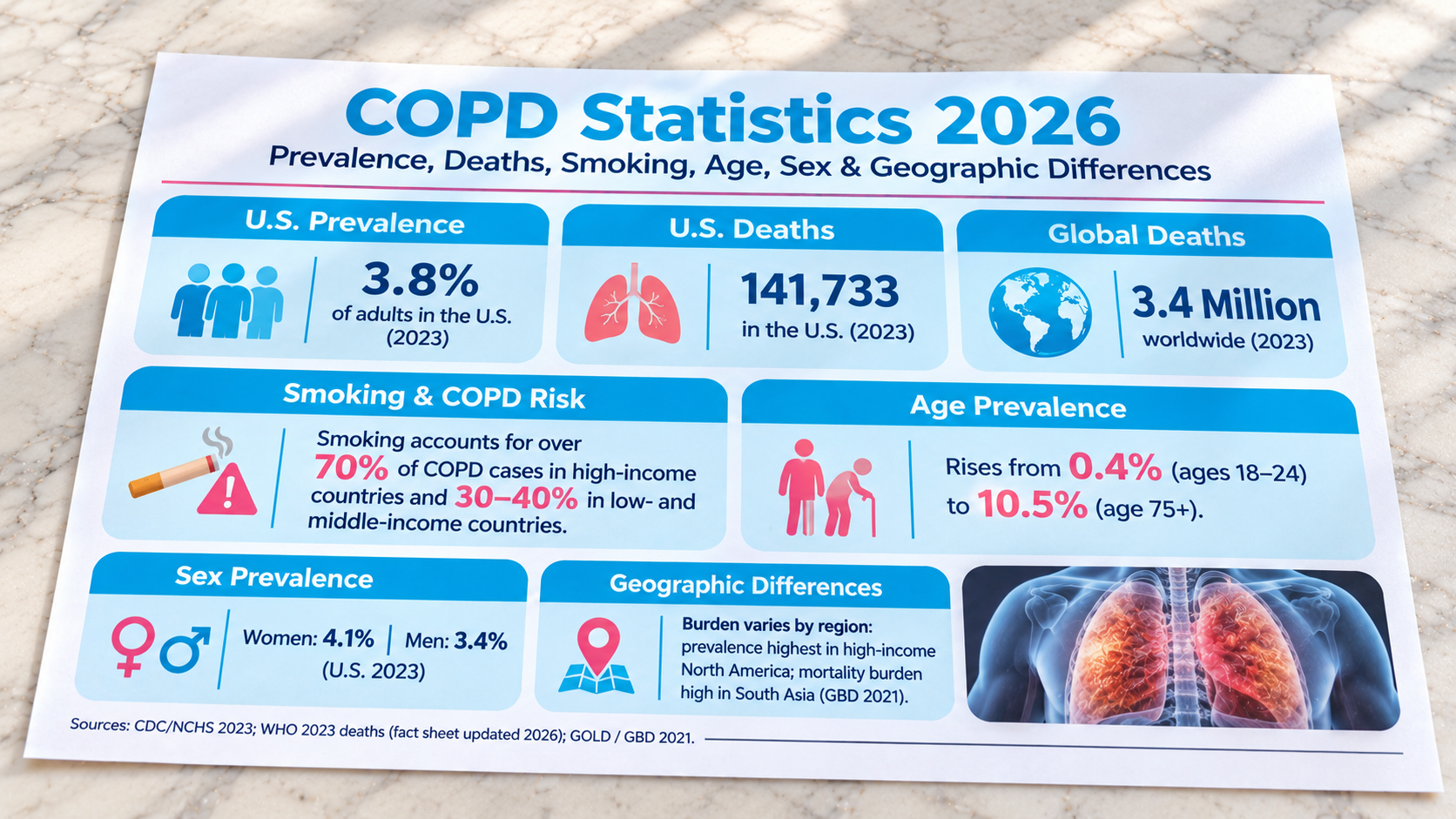
Available COPD statistics do not all describe the same year or use the same method. The newest U.S. survey figure covers 2025. A major global burden model covers 2021, and WHO’s latest death estimate covers 2023.
This page was updated in 2026, but those source years remain the observation years. [2][4][6]
Chronic obstructive pulmonary disease, or COPD, is a chronic lung condition that restricts airflow and makes breathing harder. COPD differs from asthma, though one person can have features of both.
The figures below cover prevalence, deaths, smoking, other exposures, underdiagnosis, and the methods that make credible estimates look different. Persistent breathlessness, cough, wheeze, or reduced activity tolerance deserves assessment by a qualified clinician. [9][11]
Key Takeaways: COPD Prevalence, Deaths and Smoking
- The latest U.S. figure shows that 4.4% of adults reported ever being diagnosed with COPD, emphysema, or chronic bronchitis in 2025. [2]
- The GBD 2021 model estimated 213.39 million prevalent COPD cases worldwide, and WHO estimated 3.4 million COPD deaths in 2023. [4][6]
- U.S. vital records counted 141,733 COPD deaths in 2023, a COPD-specific figure that should not be confused with the broader chronic lower respiratory disease category. [1][2]
- Tobacco smoking is a major COPD risk factor. Other recognized risks include secondhand smoke, occupational exposures, air pollution, asthma, impaired lung growth, and genetic susceptibility. [6][9][10][11]
- Adults 21 and older who already smoke or vape and want to remove nicotine from a familiar ritual can compare ARRØ’s 0% nicotine options, which preserve a hand-to-mouth and inhalation format without nicotine. ARRØ products are not COPD treatments or approved cessation aids, and inhalation is not risk-free.
COPD Statistics at a Glance
The clearest COPD statistics identify the population, geography, method, and observation year beside every number.
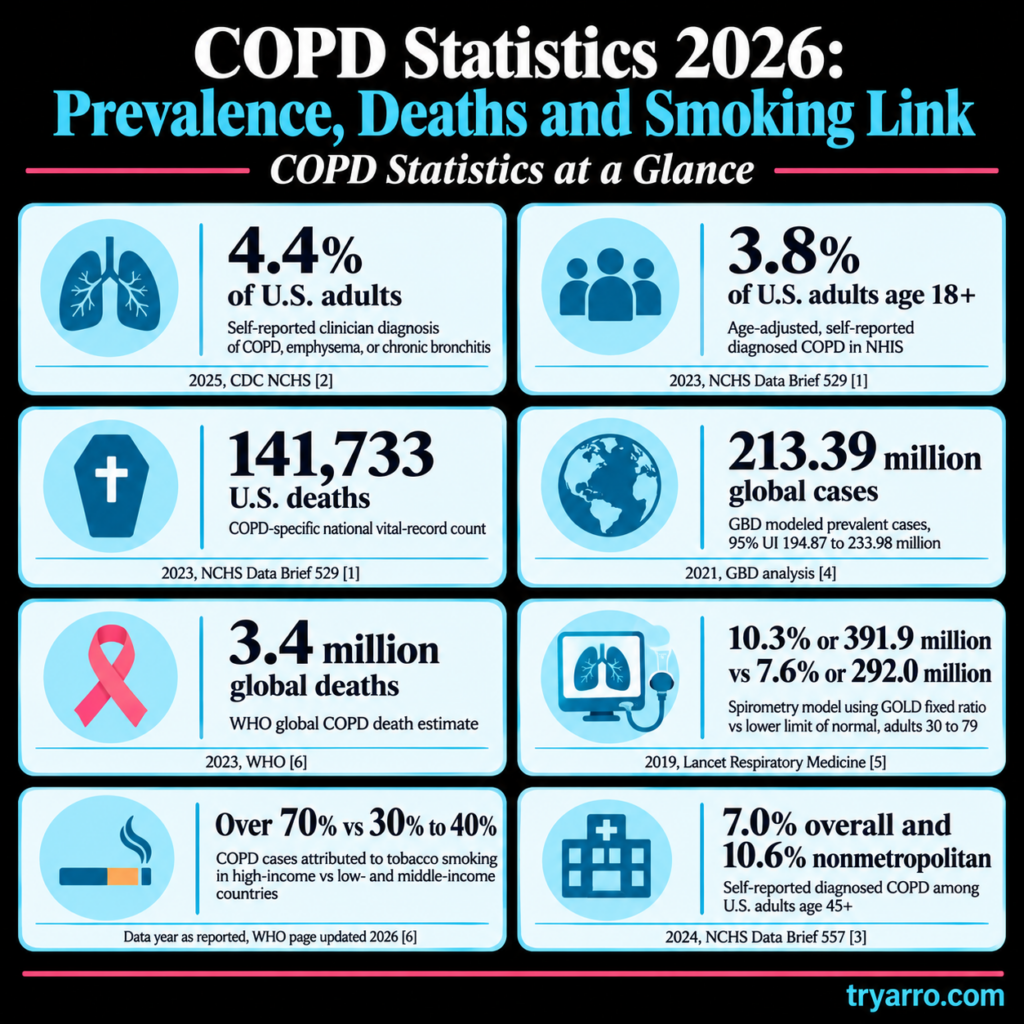
| Statistic | What it measures | Year + source |
| 4.4% of U.S. adults | Self-reported clinician diagnosis of COPD, emphysema, or chronic bronchitis | 2025, CDC NCHS [2] |
| 3.8% of U.S. adults age 18+ | Age-adjusted, self-reported diagnosed COPD in NHIS | 2023, NCHS Data Brief 529 [1] |
| 141,733 U.S. deaths | COPD-specific national vital-record count | 2023, NCHS Data Brief 529 [1] |
| 213.39 million global cases | GBD modeled prevalent cases, 95% UI 194.87 to 233.98 million | 2021, GBD analysis [4] |
| 3.4 million global deaths | WHO global COPD death estimate | 2023, WHO [6] |
| 10.3% or 391.9 million vs 7.6% or 292.0 million | Spirometry model using GOLD fixed ratio vs lower limit of normal, adults 30 to 79 | 2019, Lancet Respiratory Medicine [5] |
| Over 70% vs 30% to 40% | COPD cases attributed to tobacco smoking in high-income vs low- and middle-income countries | Data year as reported, WHO page updated 2026 [6] |
| 7.0% overall and 10.6% nonmetropolitan | Self-reported diagnosed COPD among U.S. adults age 45+ | 2024, NCHS Data Brief 557 [3] |
These figures are not directly comparable because the populations, definitions, and methods differ. The article update year is 2026.
How Common Is COPD in the United States?
In 2025, 4.4% of U.S. adults reported ever being diagnosed with COPD, emphysema, or chronic bronchitis. [2] This National Health Interview Survey measure is self-reported and reflects a clinician diagnosis recalled by the respondent.
A more detailed 2023 NHIS analysis estimated age-adjusted diagnosed COPD prevalence at 3.8% among U.S. adults age 18 and older. [1] The 4.4% and 3.8% figures use different displayed measures and analytic treatment, so they do not establish a direct year-to-year increase.
Here is the catch. A survey can estimate how many people remember a clinician diagnosing them. It cannot find everyone with undiagnosed airflow obstruction, and some reported diagnoses may never have been confirmed with post-bronchodilator spirometry.
COPD Prevalence by Age and Sex
COPD prevalence rose sharply with age in 2023 and was higher among women (4.1%) than men (3.4%). [1] These are population estimates, not predictions for any individual.
The age pattern was steep. Prevalence was 0.4% at ages 18 to 24, 1.4% at 25 to 44, 2.9% at 45 to 54, 7.4% at 55 to 64, 8.9% at 65 to 74, and 10.5% at age 75 and older. [1] The age-specific percentages were not age adjusted.
Longer exposure histories may contribute to this gradient, but age alone does not explain it. Survival, access to care, and the chance of receiving and recalling a diagnosis can shape a survey result. The NCHS analysis describes differences rather than proving one cause for them. [1]
COPD Prevalence by Race, Region and State
Diagnosed COPD prevalence in 2023 was lowest among Asian non-Hispanic adults (1.0%) and lowest by region in the West (3.1%), and 2022 state estimates ranged from 3% in Hawaii to 12% in West Virginia. [1][8] These estimates should not be treated as evidence of biological differences between groups.
Age-adjusted prevalence was 1.0% among Asian non-Hispanic adults, 2.0% among Hispanic adults, 3.5% among Black non-Hispanic adults, 4.4% among White non-Hispanic adults, and 5.3% among adults categorized as other or multiple race. [1] The full survey categories and the age adjustment are important parts of the measure.
By region, prevalence was 4.2% in both the Midwest and South, 3.4% in the Northeast, and 3.1% in the West in 2023. [1] Separate 2022 BRFSS estimates ranged from 3% in Hawaii to 12% in West Virginia. [8] These descriptive estimates do not identify why rates differ.
Urban and Rural Differences
Among U.S. adults age 45 and older in 2024, diagnosed COPD prevalence was 10.6% in nonmetropolitan areas and 5.4% in large central metropolitan areas. [3] The national estimate for that age-restricted population was 7.0%. [3]
The estimates show an urbanization gradient, but they do not prove that location itself causes COPD. [3] The 45-and-older measure cannot be compared directly with the all-adult 4.4% figure or the age-adjusted 3.8% estimate.
How Common Is COPD Worldwide?
The GBD 2021 model estimated 213.39 million prevalent COPD cases worldwide, with a 95% uncertainty interval of 194.87 million to 233.98 million. [4] The model estimated an age-standardized prevalence of 2,512.86 per 100,000 people in 2021. [4]
These are modeled burden estimates, not a literal count of people with recorded diagnoses. GBD combines data from multiple sources, adjusts inputs that use different case definitions, and carries model uncertainty through its results. [4]
Global estimates vary because studies cover different age ranges, use different spirometry thresholds, and have unequal data availability. A credible range is more honest than one supposedly definitive number.
Spirometry-Based Global Estimates
A 2019 model estimated COPD prevalence at 10.3%, or 391.9 million cases, among adults ages 30 to 79 using the GOLD fixed-ratio definition. [5] The 95% confidence intervals were 8.2% to 12.8% and 312.6 million to 487.9 million cases. [5]
Using a lower-limit-of-normal definition, the same analysis estimated 7.6% prevalence and 292.0 million cases in the same age group. [5] That lower estimate had a 95% confidence interval of 5.8% to 10.1%, or 219.8 million to 385.6 million cases. [5]
The 2019 spirometry model does not invalidate the 213.39 million GBD 2021 estimate. The age bands, case definitions, and modeling systems are different. The gap shows how much the answer changes when the denominator and diagnostic threshold change.
How Many People Die From COPD?
WHO estimated 3.4 million global COPD deaths in 2023, the GBD 2021 model estimated 3.72 million, and U.S. vital records counted 141,733 COPD deaths in 2023. [1][4][6]
These figures are not interchangeable because WHO and GBD report global estimates, but the U.S. figure is a national vital-record count.
Mortality trends need two views. The absolute number of deaths can rise as a population grows and ages, even as an age-standardized mortality rate falls. [4] Neither pattern should be relabeled as an observed 2026 result.
Global COPD Deaths and Mortality Trends
WHO estimated that COPD caused 3.4 million deaths in 2023, about 6% of all global deaths, making it the third leading cause of death worldwide. [6] This is a global estimate, not a tally of death certificates collected under one uniform system.
The GBD 2021 model estimated 3.72 million COPD deaths, with a 95% uncertainty interval of 3.35 million to 4.08 million. [4] It estimated that absolute COPD deaths rose from 2.50 million in 1990 to 3.72 million in 2021, and the age-standardized mortality rate fell by 37.12%. [4]
Both trends can be true at once. Population growth and aging can raise the death count even as the adjusted rate declines. The comparison covers 1990 to 2021, not 2026.
U.S. COPD Deaths Versus All Chronic Lower Respiratory Disease Deaths
U.S. vital records counted 141,733 COPD deaths in 2023, when COPD ranked fifth among causes of death in the NCHS analysis. [1] This is a COPD-specific national count.
CDC FastStats reports 145,643 deaths from chronic lower respiratory diseases in 2024, with an age-adjusted rate of 42.8 per 100,000. [2] That broader category includes asthma and should not be called a COPD-only count.
That full label matters. COPD is part of the chronic lower respiratory disease category, but the category includes deaths from other conditions too. The two totals come from different years.
What Is the Link Between Smoking and COPD?
Tobacco smoking is a major COPD risk factor and the most common cause in the United States, but smoking does not account for every case. [6][9][10] WHO attributes more than 70% of COPD cases in high-income countries and 30% to 40% in low- and middle-income countries to tobacco smoking. [6]
Those percentages describe populations. They cannot predict whether one person has COPD or assign a cause to one diagnosis. Household air pollution and other exposures carry more of the burden in some settings. [6]
In a 2021 BRFSS analysis, about 25% of U.S. adults with diagnosed COPD reported never smoking. [7] The 25% figure makes one point clear. Smoking does not explain every diagnosed case, but it remains central to COPD risk. ARRØ’s smoking statistics guide provides broader tobacco-use context, but COPD risk still needs its own disease-specific evidence.
Secondhand Smoke and Occupational Exposures
Secondhand tobacco smoke and workplace dusts, fumes, vapors, and smoke are recognized COPD exposures. [9][10][11] Reducing exposure at home and work is part of prevention and management guidance. [11][14]
The 2019 global spirometry model reported an odds ratio of 1.4 for occupational dust or smoke exposure. [5] The model reported an odds ratio of 1.4 for biomass exposure. [5] An odds ratio describes an association in the analyzed studies, not the percentage of COPD cases caused by that exposure.
Household air pollution from solid-fuel cooking and heating remains especially relevant in many low- and middle-income settings. [6][10] Ambient air pollution contributes to COPD burden. Readers comparing tobacco-related diseases can use ARRØ’s lung cancer statistics as a separate resource, but lung cancer and COPD have different case definitions and outcomes.
Other Recognized COPD Risk Factors
Other recognized COPD risks include long-term air pollution exposure, asthma, impaired lung growth, early-life respiratory factors, and genetic susceptibility such as alpha-1 antitrypsin deficiency. [9][10][11] These risks can interact with smoking and occupational exposures.
A risk factor still is not a diagnosis. One person can have several exposures without COPD, but another develops the disease without ever smoking cigarettes. Symptoms and exposure history create a reason for clinical assessment, not a basis for self-diagnosis.
COPD is distinct from asthma. Both can cause airflow problems, and features can coexist, but a clinician must evaluate the pattern, history, and test results. [9][11]
Diagnosed COPD Versus Estimated Undiagnosed Disease
Diagnosed prevalence counts people who report a clinician diagnosis, but spirometry studies identify airflow obstruction under a specified test definition. Neither measure perfectly captures every true COPD case.
In NHANES 2007 to 2012, about 5.2% of U.S. adults ages 40 to 79 reported diagnosed COPD. Among adults in the same age range who did not report a COPD diagnosis, nearly 13% had spirometric evidence of obstruction. [13] Most of that obstruction was mild, and the study used pre-bronchodilator testing. [13]
Airflow obstruction alone should not automatically be called confirmed COPD. GOLD requires post-bronchodilator spirometry showing FEV1/FVC below 0.7 in an appropriate clinical context that includes symptoms and risk factors. [11] Asthma, test quality, treatment effects, and other conditions can complicate interpretation.
What Underdiagnosis and Overdiagnosis Studies Show
A 2023 systematic review found both missed COPD and clinical labels that lacked post-bronchodilator confirmation in primary care. Across three included studies, 14% to 26% of symptomatic smokers had undiagnosed spirometry-confirmed COPD. [12]
In four adequately powered case series, 25% to 50% of people with a COPD label did not show post-bronchodilator airflow obstruction when researchers tested them. [12] That range should not be extrapolated to the entire U.S. population.
The review found heterogeneous evidence of modest quality. [12] The takeaway is diagnostic uncertainty and the need for proper spirometry. The review does not provide a current national case count.
Why Survey and Spirometry Estimates Differ
Survey and spirometry estimates differ because they measure different stages of care and use different definitions. Surveys depend on access to care, clinician labeling, recall, and question wording. They can miss undiagnosed disease and include labels that were not objectively confirmed.
Spirometry estimates depend on whether testing happens before or after a bronchodilator and which threshold defines obstruction. A fixed FEV1/FVC ratio below 0.7 can classify more older adults as obstructed than a lower-limit-of-normal threshold. [5][11]
Modeled burden studies combine heterogeneous inputs, adjust for biases, and report uncertainty intervals rather than direct headcounts. [4] Each method answers a real question. No result should be used without its population, geography, year, and definition.
What Smoking Cessation Changes for COPD Risk and Progression
Stopping smoking is the most important modifiable step for someone who smokes and has COPD or is at risk. Smoking cessation can slow COPD progression, reduce the loss of lung function over time, and improve respiratory symptoms, but it does not guarantee reversal or restore normal lung function. [11][14]
Clinician support, counseling, and approved cessation medications can improve the chances of stopping tobacco use. [14] Anyone with persistent breathing symptoms should seek medical evaluation rather than trying to diagnose or treat COPD alone.
Adults 21 and older who already smoke or vape may want to keep the ritual and remove nicotine. ARRØ’s nicotine-free vape options use a familiar hand-to-mouth and inhalation format with 0% nicotine.
That removes nicotine from this specific product ritual, but it does not treat COPD or replace evidence-based cessation care. ARRØ is not a COPD treatment, prevention product, or approved smoking cessation aid, and inhalation is not risk-free.
Some people want to avoid inhalation entirely while changing a routine. ARRØ’s guide to oral fixation alternatives compares non-inhaled options such as straws, gum, adult chew tools, and breathing cues alongside inhaled formats. Nicotine withdrawal and COPD symptoms still belong with qualified health professionals.
Limits of COPD Statistics
COPD statistics are limited by the age range, geography, wording, test protocol, case definition, and model behind each estimate. A number without those labels can look more precise than it really is.
National vital records count certified causes of death under one country’s coding system. Global burden estimates use models to fill data gaps across countries. [4][6] Projections describe possible futures and should never be presented as recorded deaths.
Uncertainty intervals matter because model inputs and assumptions are not exact. Survey estimates have sampling error and can exclude institutionalized populations. [1][3][13] When measures do not match, showing both with their limits is more accurate than forcing a smooth trend.
Frequently Asked Questions About COPD Statistics
U.S. and global COPD totals differ because sources use different observation years, populations, testing methods, and case definitions.
How Many People Have COPD in the United States?
The latest headline measure is that 4.4% of U.S. adults reported ever being diagnosed with COPD, emphysema, or chronic bronchitis in 2025. [2] A detailed 2023 analysis estimated age-adjusted diagnosed COPD prevalence at 3.8% among adults age 18 and older. [1] The measures differ, so they should not be treated as a direct annual trend.
How Many People Have COPD Worldwide?
The GBD 2021 model estimated 213.39 million prevalent COPD cases worldwide. [4] A separate 2019 spirometry-based model estimated 391.9 million cases among adults ages 30 to 79 using the GOLD fixed-ratio definition. [5] Different age ranges, definitions, and modeling systems explain much of the gap.
What Percentage of COPD Is Linked to Smoking?
WHO attributes more than 70% of COPD cases in high-income countries and 30% to 40% in low- and middle-income countries to tobacco smoking. [6] Those are population-level attribution summaries, not an individual diagnosis or risk prediction.
Can Nonsmokers Develop COPD?
Yes, people who have never smoked can develop COPD. About one in four U.S. adults with diagnosed COPD in a 2021 BRFSS analysis reported never smoking. [7] Secondhand smoke, occupational exposures, air pollution, asthma, impaired lung growth, and genetic factors are among the recognized risks. [9][10][11]
Is COPD the Same as Asthma?
No, COPD and asthma are distinct chronic lung conditions, but one person can have features of both. [9][11] This is one reason the 2024 chronic lower respiratory disease death count, which includes asthma, must not be presented as a COPD-only total. [2]
Can Quitting Smoking Reverse COPD?
Quitting smoking can slow progression and improve respiratory health, but it does not reliably reverse established COPD or restore normal lung function. [11][14] Treatment can reduce symptoms and exacerbations, and COPD requires professional medical care.
Use the Numbers to Take the Next Safe Step
COPD statistics describe populations, not an individual diagnosis. Seek prompt professional care for persistent breathlessness, chronic cough, wheeze, or falling exercise capacity. [9][11]
If you smoke, start with a clinician or established quit-support service for evidence-based help. ARRØ’s smoking cessation statistics guide explains how different quit-rate measures and study endpoints should be interpreted without turning consumer products into proven treatments. Use those definitions to judge quit claims and choose a support option with clearer expectations.
References
[1] Weeks, Julie D., and Nazik Elgaddal. “Chronic Obstructive Pulmonary Disease in Adults Age 18 and Older: United States, 2023.” NCHS Data Brief, no. 529, May 2025, Centers for Disease Control and Prevention.
[2] National Center for Health Statistics. “Chronic Obstructive Pulmonary Disease (COPD).” FastStats, Centers for Disease Control and Prevention, 2026.
[3] Wang, Xun, and Lindsey I. Black. “Prevalence of Selected Chronic Conditions Among Adults Age 45 and Older, by Age and Urbanization Level: United States, 2024.” NCHS Data Brief, no. 557, 15 Apr. 2026, Centers for Disease Control and Prevention.
[4] Wang, Zhufeng, et al. “Global, Regional, and National Burden of Chronic Obstructive Pulmonary Disease and Its Attributable Risk Factors from 1990 to 2021: An Analysis for the Global Burden of Disease Study 2021.” Respiratory Research, vol. 26, article 2, 2 Jan. 2025.
[5] Adeloye, Davies, et al. “Global, Regional, and National Prevalence of, and Risk Factors for, Chronic Obstructive Pulmonary Disease (COPD) in 2019: A Systematic Review and Modelling Analysis.” The Lancet Respiratory Medicine, vol. 10, no. 5, 2022, pp. 447 to 458.
[6] World Health Organization. “Chronic Obstructive Pulmonary Disease (COPD).” 10 June 2026.
[7] Liu, Yong, et al. “Trends in the Prevalence of Chronic Obstructive Pulmonary Disease Among Adults Aged 18 Years and Older, United States, 2011 to 2021.” Morbidity and Mortality Weekly Report, vol. 72, no. 46, 17 Nov. 2023, pp. 1250 to 1256.
[8] Centers for Disease Control and Prevention. “State Estimates of COPD.” 15 May 2024.
[9] Centers for Disease Control and Prevention. “About COPD.” 15 May 2024.
[10] National Heart, Lung, and Blood Institute. “COPD Causes and Risk Factors.” National Institutes of Health, 30 Apr. 2024.
[11] Global Initiative for Chronic Obstructive Lung Disease. “Global Strategy for Prevention, Diagnosis and Management of COPD: 2026 Report.” 2026.
[12] Perret, Jennifer, et al. “Undiagnosed and ‘Overdiagnosed’ COPD Using Postbronchodilator Spirometry in Primary Healthcare Settings: A Systematic Review and Meta-Analysis.” BMJ Open Respiratory Research, vol. 10, 2023, article e001478.
[13] Tilert, Timothy, et al. “Prevalence and Factors Associated with Self-Reported Chronic Obstructive Pulmonary Disease Among Adults Aged 40 to 79: The National Health and Nutrition Examination Survey 2007 to 2012.” EC Pulmonology and Respiratory Medicine, vol. 7, no. 9, 2018, pp. 650 to 662.
[14] Centers for Disease Control and Prevention. “Smoking and COPD.” Tips From Former Smokers, 15 May 2024.
[15] Centers for Disease Control and Prevention. “National Trends in COPD.” 15 May 2024.
 Cessation Cravings: