



In 2025, 5.2% of U.S. students in grades 6 through 12 reported past-30-day e-cigarette use [1], an estimated 1.44 million students. How many students have ever tried a vape, and how many vape daily? Those questions use different time frames or different groups of students. This 2026 guide explains what each measure counts, using U.S. data collected from 2022 through 2025.
Key Takeaways on Teen Vaping Statistics
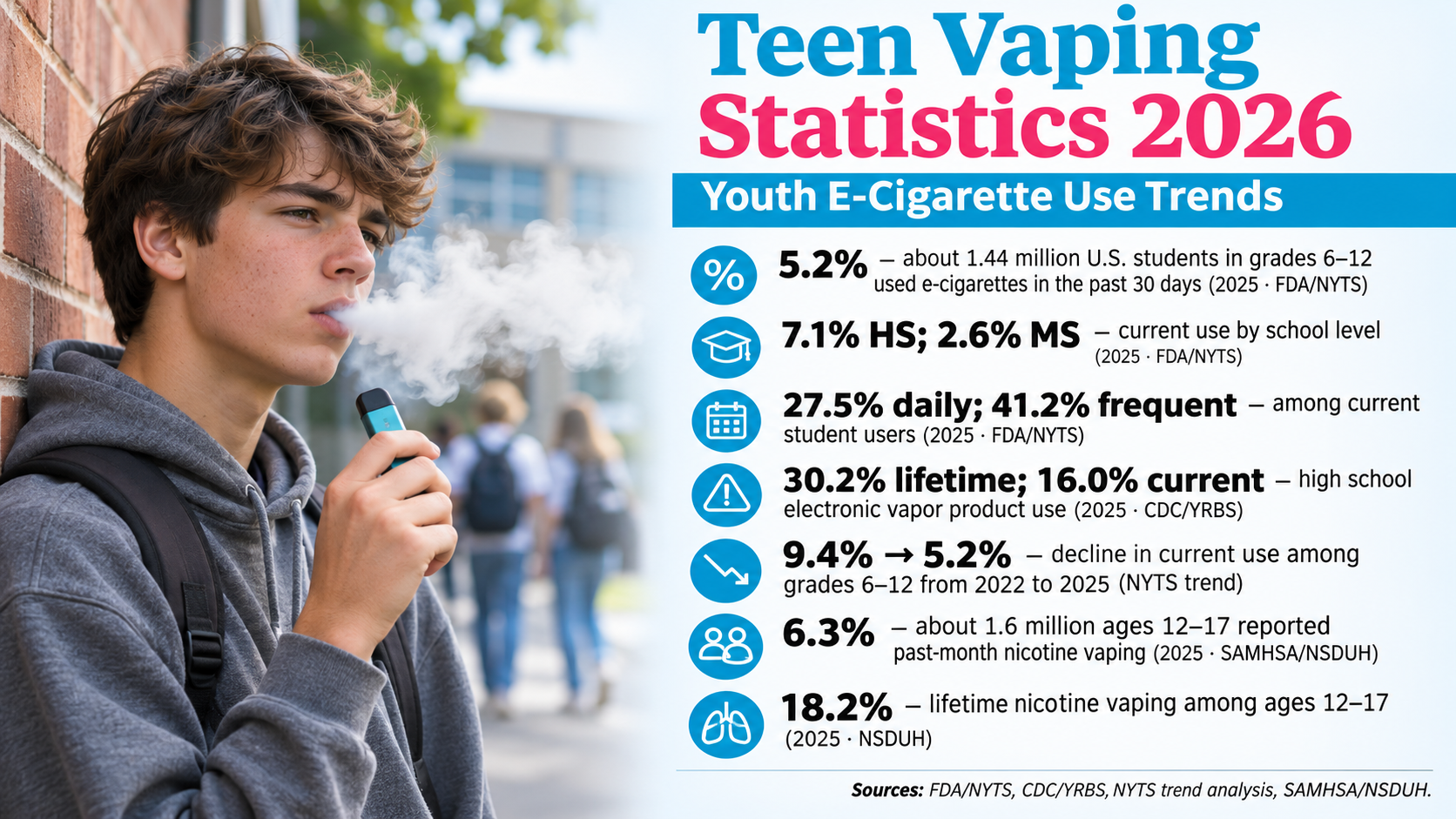
- In the 2025 National Youth Tobacco Survey, 5.2% of U.S. students in grades 6 through 12 reported past-30-day e-cigarette use [1], including 7.1% of high school students and 2.6% of middle school students.
- Among U.S. students in grades 6 through 12 who used e-cigarettes in the past 30 days in 2025, 27.5% reported daily e-cigarette use [1] in the National Youth Tobacco Survey.
- In the 2025 Youth Risk Behavior Survey, 30.2% of U.S. students in grades 9 through 12 had ever used vapor products [2] and 16.0% had used them in the past 30 days.
- U.S. student e-cigarette use [3] in the past 30 days fell from 9.4% in 2022 to 5.2% in 2025 among students in grades 6 through 12 in the National Youth Tobacco Survey.
- In the 2025 National Survey on Drug Use and Health, 6.3% of U.S. adolescents ages 12 through 17 reported past-month nicotine vaping [4].
Teen Vaping Statistics Summary
Percentages and population counts are weighted survey estimates based on what respondents reported. Use the school grade or age range shown in each row when quoting a number.
| Statistic | What it measures | Year + source |
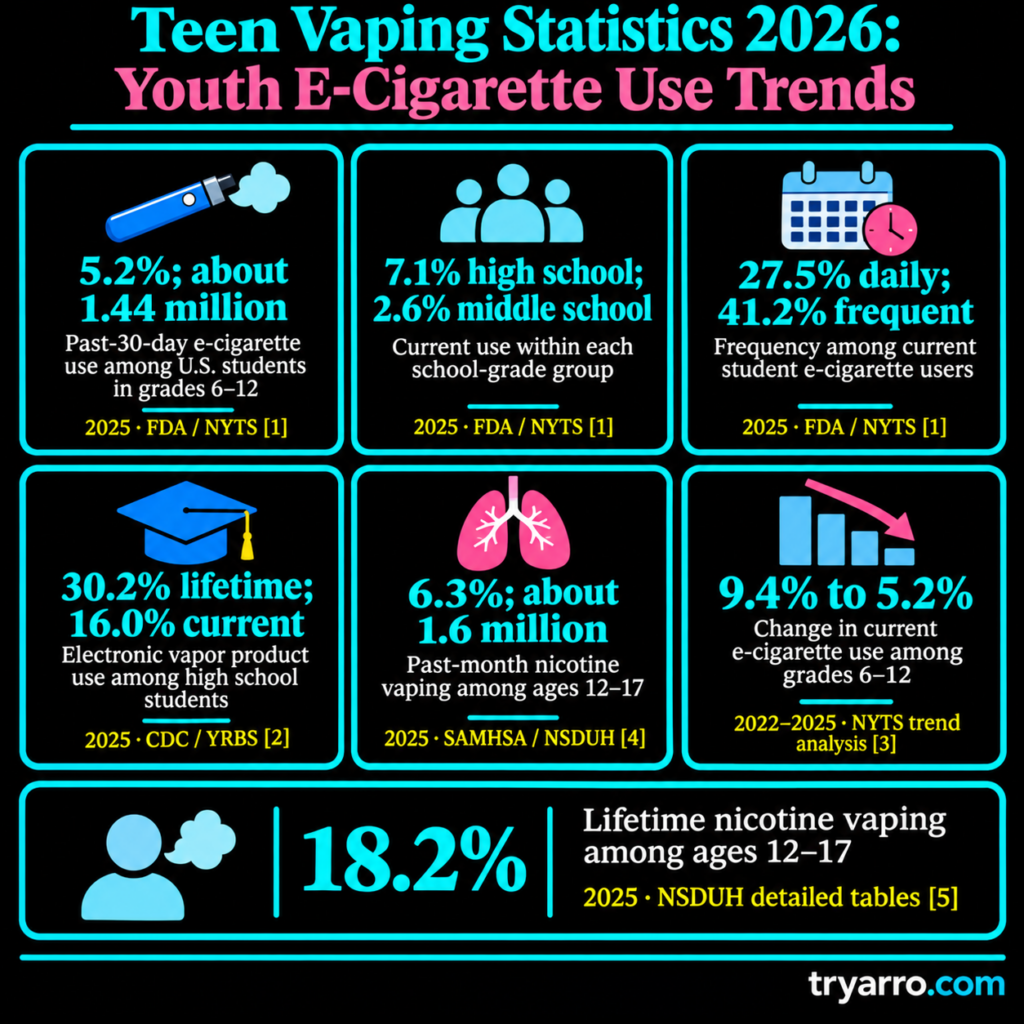
| 5.2%; about 1.44 million | Past-30-day e-cigarette use among U.S. students in grades 6–12 | 2025 · FDA / NYTS [1] |
| 7.1% high school; 2.6% middle school | Current use within each school-grade group | 2025 · FDA / NYTS [1] |
| 27.5% daily; 41.2% frequent | Frequency among current student e-cigarette users | 2025 · FDA / NYTS [1] |
| 30.2% lifetime; 16.0% current | Electronic vapor product use among high school students | 2025 · CDC / YRBS [2] |
| 9.4% to 5.2% | Change in current e-cigarette use among grades 6–12 | 2022–2025 · NYTS trend analysis [3] |
| 6.3%; about 1.6 million | Past-month nicotine vaping among ages 12–17 | 2025 · SAMHSA / NSDUH [4] |
| 18.2% | Lifetime nicotine vaping among ages 12–17 | 2025 · NSDUH detailed tables [5] |
Vaping Prevalence by School Grade
In the 2025 National Youth Tobacco Survey findings [1], current e-cigarette use was more common in high school (grades 9 through 12) than in middle school (grades 6 through 8). These are enrollment groups, so their prevalence rates answer a question about students rather than a fixed age range.
Middle School and High School
In the 2025 school-based National Youth Tobacco Survey analysis [3], 7.1% of U.S. high school students reported past-30-day e-cigarette use (95% confidence interval, 6.3% to 8.1%), compared with 2.6% of middle school students (95% confidence interval, 2.1% to 3.2%). Each rate uses the students in its own grade group as the denominator.
The national student sample in the NYTS analysis [3] included 23,630 students, with an overall response rate of 29.7%. The research team weighted the responses to represent the national school population. Participation and self-reporting can still affect the estimates. A national rate also leaves room for variation from one school or community to another.
Lifetime Use Among High School Students
In the 2025 national YRBS, 30.2% of U.S. students in grades 9 through 12 said they had ever used a vapor product [2]. When asked about the preceding 30 days, 16.0% reported using one. Both estimates use the national high school population represented by the YRBS. A student who took a single puff months before the survey could count toward lifetime use, while the past-30-day figure captures recent use.
Daily and Frequent Vaping Among Current Users
In the 2025 U.S. NYTS, daily e-cigarette use among current student users [1] was reported by 27.5% of current e-cigarette users in grades 6 through 12. The people counted in this group said they used e-cigarettes on all 30 of the preceding 30 days. In the same group of current users, frequent e-cigarette use among current student users [1] reached 41.2%, under a definition of at least 20 of those 30 days. The frequent-use group already includes students who vaped daily, so adding the percentages would count them twice.
The NYTS estimate of daily vaping among current student users [1] uses a narrower denominator than the overall prevalence rate. A student must first qualify as a current user to be included in that frequency calculation. Applying the daily-use percentage to all students would substantially overstate how common daily vaping is across the school population.
Nicotine Vaping at Ages 12 Through 17
The 2025 age-based National Survey on Drug Use and Health [4] estimated that 6.3% of U.S. adolescents ages 12 through 17 vaped nicotine in the past month. This survey classifies adolescents by their age at interview and represents the civilian, noninstitutionalized population.
An Age-Based National Estimate
In the 2025 NSDUH, 6.3% of U.S. adolescents ages 12 through 17 reported nicotine vaping in the past month [4], an estimated 1.6 million adolescents. The survey represents the U.S. civilian, noninstitutionalized population and defines the group by age. It includes 12-year-olds and ends before age 18. Middle or high school grade is irrelevant to that age-based definition.
In 2025, 18.2% of U.S. adolescents ages 12 through 17 had ever vaped nicotine, according to the NSDUH detailed tables on lifetime nicotine vaping [5]. The NSDUH definition of nicotine vaping [6] asks about an e-cigarette or other device used to vape nicotine. The distinction matters when citing surveys on electronic vapor products that use a different question.
Youth E-Cigarette Trends in U.S. Surveys
Past-30-day e-cigarette use among U.S. students in grades 6 through 12 fell significantly in the 2022 to 2025 National Youth Tobacco Survey analysis [3]. A separate SAMHSA’s age-based nicotine vaping series [4] found no statistically significant change in past-month use over the same period among U.S. adolescents ages 12 through 17.
National Youth Tobacco Survey Trends
Current e-cigarette use fell from 9.4% in 2022 to 5.2% in 2025 among U.S. students in grades 6 through 12, according to the FDA’s NYTS trend analysis [3]. Among high school students in grades 9 through 12, the estimate fell from 14.1% to 7.1% over the same period. Both declines were statistically significant. The analysis used the proportion reporting use on at least one of the preceding 30 days.
The NYTS trend for middle school e-cigarette use [3] depends on the comparison period. For U.S. grades 6 through 8, the FDA found a statistically significant decrease from 3.5% in 2024 to 2.6% in 2025. Its test of the full 2022 through 2025 trend for those grades found no statistically significant change. The one-year comparison and the multiyear analysis answer different questions.
Nicotine Vaping Trends by Age
The NSDUH found no statistically significant change in the adolescent nicotine vaping series [4] in past-month nicotine vaping from 2022 to 2025 among U.S. adolescents ages 12 through 17. The estimates were 6.8% in 2022, 6.8% in 2023, 6.0% in 2024 and 6.3% in 2025. These figures come from the same release, which revised earlier estimates to reflect updates to how the survey data were processed.
How Survey Questions Affect Comparisons
Keep trends within the same survey and check that the wording, population and reference period match. NYTS measures e-cigarette use in a school-based tobacco survey, YRBS measures electronic vapor product use in a broader school-based health survey, and NSDUH measures nicotine vaping in an age-based substance use survey. Even where the school grades overlap, different questionnaires and survey designs can yield different estimates. Use the NYTS survey methods [3], YRBS survey methods [2] and NSDUH measure definition [6] to check compatibility before combining any figures.
For a comparison across nicotine products and age groups, ARRØ’s U.S. nicotine statistics on use and dependence provide broader context. The teen estimates here remain tied to their school-grade or age-based survey populations.
Teen Vaping FAQs
What percentage of U.S. middle and high school students vape?
In the 2025 National Youth Tobacco Survey, 5.2% of U.S. students in grades 6 through 12 reported using e-cigarettes recently [1], meaning on at least one day in the past 30 days. The rate was 7.1% among high school students and 2.6% among middle school students.
How many U.S. teens vape nicotine?
The 2025 National Survey on Drug Use and Health estimated that 1.6 million U.S. adolescents ages 12 through 17 vaped nicotine in the past month [4], or 6.3% of the civilian, noninstitutionalized population in that age group.
What is the difference between ever and current vaping?
Ever use counts anyone who has tried the product by the time of the survey. Current use counts people who report use in the past 30 days [2], even if they used the product only once in that window. In the 2025 national YRBS, these definitions apply to electronic vapor products among U.S. high school students.
How common is daily vaping among students who vape?
In the 2025 U.S. NYTS, 27.5% of students in grades 6 through 12 who had used e-cigarettes in the past 30 days reported vaping daily [1], meaning they used e-cigarettes on each of those 30 days.
Is youth vaping declining in the United States?
The FDA found a statistically significant decline in current use [3] among U.S. students in grades 6 through 12, from 9.4% in 2022 to 5.2% in 2025. For U.S. adolescents ages 12 through 17, SAMHSA’s separate nicotine vaping series [4] showed no statistically significant change in past-month use over the same period.
References and Sources
- FDA, 2025 National Youth Tobacco Survey Results (2026).
- CDC, 2025 Youth Risk Behavior Survey Substance Use Analysis (2026), Table 2.
- Park-Lee et al., 2025 National Youth Tobacco Survey Analysis (2026), Tables 1 through 3.
- SAMHSA, 2025 NSDUH National Report (2026), Figure 7 and Table A.1B.
- SAMHSA, 2025 NSDUH Detailed Tables (2026), Table 9.22B.
- SAMHSA, 2025 NSDUH Methodological Summary and Definitions (2026), section 3.4.4.
 Cessation Cravings: