





By Devon McPherson
Smoking continues to decline in the United States, but national averages hide substantial differences by age and location. The latest preliminary estimate puts adult cigarette smoking at 9.1% in 2025, according to CDC’s National Health Interview Survey. Globally, WHO’s 2025 tobacco trends report estimates that 847 million people smoked cigarettes in 2024. [1][6]
The tables below bring together the latest available national, state and country figures. Each table identifies its data year and population so you can compare the right measures.
Key smoking statistics
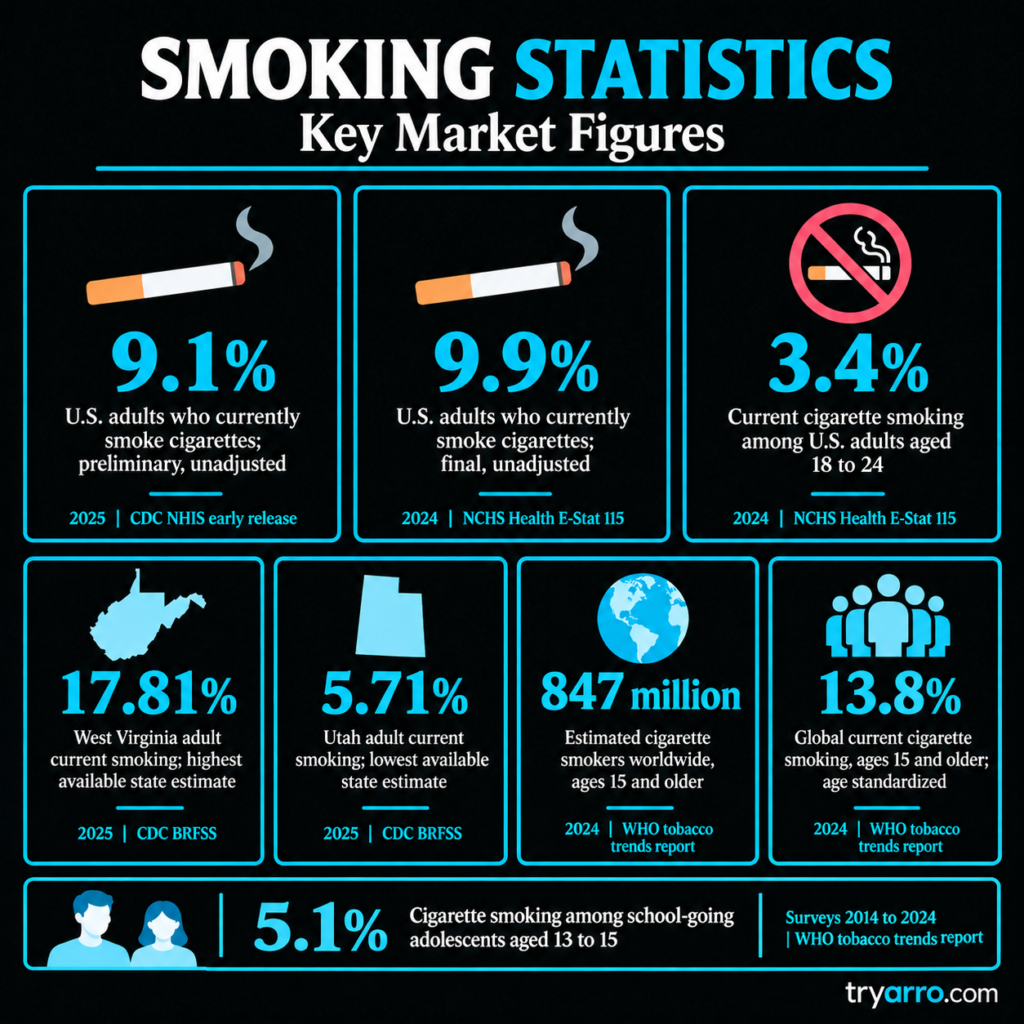
| Statistic | What it measures | Year + source |
| 9.1% | U.S. adults who currently smoke cigarettes; preliminary, unadjusted | 2025 | CDC NHIS early release |
| 9.9% | U.S. adults who currently smoke cigarettes; final, unadjusted | 2024 | NCHS Health E-Stat 115 |
| 3.4% | Current cigarette smoking among U.S. adults aged 18 to 24 | 2024 | NCHS Health E-Stat 115 |
| 17.81% | West Virginia adult current smoking; highest available state estimate | 2025 | CDC BRFSS |
| 5.71% | Utah adult current smoking; lowest available state estimate | 2025 | CDC BRFSS |
| 847 million | Estimated cigarette smokers worldwide, ages 15 and older | 2024 | WHO tobacco trends report |
| 13.8% | Global current cigarette smoking, ages 15 and older; age standardized | 2024 | WHO tobacco trends report |
| 5.1% | Cigarette smoking among school-going adolescents aged 13 to 15 | Surveys 2014 to 2024 | WHO tobacco trends report |
How many adults smoke in the United States?
CDC’s preliminary 2025 NHIS release estimates that 9.1% of U.S. adults currently smoked cigarettes, with a 95% confidence interval of 8.6% to 9.7%. These early figures can change after final processing. The latest final estimate is 9.9% for 2024, reported in NCHS Health E-Stat 115. [1][2]
In the NCHS survey, a current smoker is an adult who has smoked at least 100 cigarettes during their lifetime and now smokes every day or some days. This definition measures cigarette use, rather than every form of tobacco or nicotine use. [2]
Smoking statistics by age
Adults aged 45 to 64 had the highest current cigarette smoking rate, at 13.3%, while adults aged 18 to 24 had the lowest, at 3.4%, in 2024. The NCHS age breakdown shows that smoking remains more common in middle age even as national prevalence falls. [2]
| Age group | Current smoking | 95% confidence interval | Source |
| 18 to 24 | 3.4% | 2.6% to 4.5% | NCHS |
| 25 to 44 | 10.5% | 9.7% to 11.3% | NCHS |
| 45 to 64 | 13.3% | 12.5% to 14.2% | NCHS |
| 65 and older | 7.8% | 7.2% to 8.5% | NCHS |
Smoking statistics for men and women
Men were more likely than women to smoke cigarettes in both the U.S. and global datasets. U.S. age-adjusted prevalence was 11.8% among men and 8.4% among women in 2024, according to Healthy People 2030’s NHIS data. WHO estimated global age-standardized rates of 23.8% for men and 3.7% for women that year. [3][6]
| Dataset | Both sexes | Men | Women | Source |
| WHO global 2024, age standardized | 13.8% | 23.8% | 3.7% | WHO |
| U.S. 2024, age adjusted | 10.1% | 11.8% | 8.4% | WHO |
The U.S. series covers adults aged 18 and older and uses the U.S. standard population for age adjustment. WHO covers ages 15 and older and uses its own standard population. The rows describe each population separately.
Smoking statistics by state
West Virginia had the highest available adult current smoking estimate in 2025, at 17.81%, followed by Louisiana at 15.65% and Kentucky at 15.22%. Utah had the lowest available estimate, at 5.71%, according to CDC’s BRFSS prevalence dataset. [4]
This table uses the 2025 overall, crude-prevalence estimates for current cigarette smoking. California, Mississippi and Nevada have no matching 2025 estimate in the CDC dataset at the time of review. “Unavailable” means no estimate is listed, not zero smoking. [4]
| State or district | Current smoking | Source |
| Alabama | 11.99% | CDC BRFSS |
| Alaska | 13.46% | CDC BRFSS |
| Arizona | 7.69% | CDC BRFSS |
| Arkansas | 14.16% | CDC BRFSS |
| California | Unavailable | CDC BRFSS |
| Colorado | 8.22% | CDC BRFSS |
| Connecticut | 7.50% | CDC BRFSS |
| Delaware | 9.38% | CDC BRFSS |
| District of Columbia | 9.46% | CDC BRFSS |
| Florida | 8.97% | CDC BRFSS |
| Georgia | 9.80% | CDC BRFSS |
| Hawaii | 8.27% | CDC BRFSS |
| Idaho | 8.45% | CDC BRFSS |
| Illinois | 9.71% | CDC BRFSS |
| Indiana | 13.11% | CDC BRFSS |
| Iowa | 11.70% | CDC BRFSS |
| Kansas | 11.71% | CDC BRFSS |
| Kentucky | 15.22% | CDC BRFSS |
| Louisiana | 15.65% | CDC BRFSS |
| Maine | 12.86% | CDC BRFSS |
| Maryland | 8.28% | CDC BRFSS |
| Massachusetts | 8.23% | CDC BRFSS |
| Michigan | 10.82% | CDC BRFSS |
| Minnesota | 9.44% | CDC BRFSS |
| Mississippi | Unavailable | CDC BRFSS |
| Missouri | 14.21% | CDC BRFSS |
| Montana | 12.19% | CDC BRFSS |
| Nebraska | 11.26% | CDC BRFSS |
| Nevada | Unavailable | CDC BRFSS |
| New Hampshire | 8.20% | CDC BRFSS |
| New Jersey | 7.13% | CDC BRFSS |
| New Mexico | 10.51% | CDC BRFSS |
| New York | 9.09% | CDC BRFSS |
| North Carolina | 10.73% | CDC BRFSS |
| North Dakota | 12.44% | CDC BRFSS |
| Ohio | 14.44% | CDC BRFSS |
| Oklahoma | 13.18% | CDC BRFSS |
| Oregon | 9.95% | CDC BRFSS |
| Pennsylvania | 10.98% | CDC BRFSS |
| Rhode Island | 8.89% | CDC BRFSS |
| South Carolina | 11.23% | CDC BRFSS |
| South Dakota | 13.68% | CDC BRFSS |
| Tennessee | 14.95% | CDC BRFSS |
| Texas | 9.22% | CDC BRFSS |
| Utah | 5.71% | CDC BRFSS |
| Vermont | 9.57% | CDC BRFSS |
| Virginia | 10.11% | CDC BRFSS |
| Washington | 8.03% | CDC BRFSS |
| West Virginia | 17.81% | CDC BRFSS |
| Wisconsin | 10.79% | CDC BRFSS |
| Wyoming | 12.13% | CDC BRFSS |
Urban and rural smoking rates
Smoking was more common in rural areas in 2024. NCHS reported current smoking among 15.4% of adults in nonmetropolitan counties, compared with 8.0% in large central metropolitan counties and 8.0% in large fringe metropolitan counties. The estimate for medium and small metropolitan counties was 11.0%. [2]
How many people smoke cigarettes worldwide?
WHO’s tobacco trends report estimates that 847 million people aged 15 and older smoked cigarettes in 2024: 731 million men and 116 million women. Global age-standardized cigarette smoking prevalence was 13.8%. [6]
The wider tobacco picture is larger. WHO estimated 992 million tobacco smokers and 1.202 billion users of any tobacco product in 2024. The broader totals include products beyond cigarettes, so they answer different questions about tobacco use. [6]
Smoking statistics by country
North Macedonia had the highest 2024 age-standardized cigarette smoking estimate in the WHO country dataset, at 39.6%. Timor-Leste followed at 38.0%, Lebanon at 36.6%, Serbia at 36.0% and Bulgaria at 35.9%. Ghana had the lowest estimate among the listed countries, at 2.0%. [7]
The difference between men and women varies widely by country. WHO estimated cigarette smoking at 66.6% among men and 9.4% among women in Timor-Leste. In Serbia, the estimates were 35.3% for men and 36.7% for women. [7]
The table covers ages 15 and older and uses WHO’s age-standardized 2024 estimates. These are modelled estimates based on available national surveys, which may predate 2024. Age standardization improves comparisons between countries with different age structures. Source: WHO Global Health Observatory. [7]
| Country | Both sexes | Men | Women | Source |
| Afghanistan | 7.1% | 13.5% | 0.7% | WHO |
| Albania | 18.0% | 31.9% | 4.2% | WHO |
| Algeria | 15.0% | 29.7% | 0.3% | WHO |
| Andorra | 28.9% | 28.0% | 29.8% | WHO |
| Argentina | 21.0% | 24.2% | 17.8% | WHO |
| Armenia | 24.5% | 47.6% | 1.4% | WHO |
| Australia | 8.1% | 9.4% | 6.9% | WHO |
| Austria | 18.3% | 18.2% | 18.3% | WHO |
| Azerbaijan | 13.5% | 27.0% | 0.1% | WHO |
| Bahamas | 11.9% | 22.5% | 1.4% | WHO |
| Bahrain | 10.2% | 18.9% | 1.5% | WHO |
| Bangladesh | 12.8% | 25.4% | 0.1% | WHO |
| Belarus | 23.3% | 35.6% | 11.0% | WHO |
| Belgium | 20.5% | 22.3% | 18.7% | WHO |
| Belize | 7.2% | 12.9% | 1.6% | WHO |
| Benin | 4.0% | 7.8% | 0.3% | WHO |
| Bhutan | 5.9% | 9.7% | 2.0% | WHO |
| Bolivia (Plurinational State of) | 10.0% | 16.7% | 3.3% | WHO |
| Bosnia and Herzegovina | 29.6% | 34.3% | 24.9% | WHO |
| Botswana | 13.5% | 24.7% | 2.3% | WHO |
| Brazil | 10.2% | 13.4% | 7.1% | WHO |
| Brunei Darussalam | 12.4% | 23.2% | 1.6% | WHO |
| Bulgaria | 35.9% | 37.4% | 34.4% | WHO |
| Burkina Faso | 6.5% | 12.1% | 0.9% | WHO |
| Burundi | 6.5% | 11.9% | 1.0% | WHO |
| Cabo Verde | 5.5% | 9.8% | 1.2% | WHO |
| Cambodia | 13.2% | 24.9% | 1.5% | WHO |
| Cameroon | 4.4% | 8.7% | 0.2% | WHO |
| Canada | 8.8% | 11.0% | 6.5% | WHO |
| Chad | 5.3% | 10.1% | 0.5% | WHO |
| Chile | 23.6% | 26.2% | 21.0% | WHO |
| China | 22.7% | 44.2% | 1.3% | WHO |
| Colombia | 6.9% | 10.3% | 3.5% | WHO |
| Comoros | 4.9% | 9.5% | 0.3% | WHO |
| Congo | 11.8% | 23.1% | 0.5% | WHO |
| Cook Islands | 24.6% | 27.7% | 21.6% | WHO |
| Costa Rica | 7.2% | 10.7% | 3.6% | WHO |
| Cote d’Ivoire | 6.4% | 12.2% | 0.7% | WHO |
| Croatia | 32.1% | 33.0% | 31.2% | WHO |
| Cuba | 10.6% | 16.1% | 5.0% | WHO |
| Cyprus | 28.0% | 40.4% | 15.7% | WHO |
| Czechia | 24.4% | 27.8% | 20.9% | WHO |
| Democratic People’s Republic of Korea | 13.6% | 27.2% | 0.0% | WHO |
| Democratic Republic of the Congo | 8.5% | 16.6% | 0.4% | WHO |
| Denmark | 10.6% | 10.5% | 10.7% | WHO |
| Ecuador | 8.5% | 15.1% | 1.9% | WHO |
| Egypt | 20.1% | 40.1% | 0.1% | WHO |
| El Salvador | 7.1% | 12.4% | 1.8% | WHO |
| Estonia | 21.8% | 25.5% | 18.2% | WHO |
| Eswatini | 8.3% | 15.7% | 0.9% | WHO |
| Ethiopia | 3.0% | 5.5% | 0.5% | WHO |
| Fiji | 22.3% | 33.6% | 11.0% | WHO |
| Finland | 12.3% | 13.6% | 11.0% | WHO |
| France | 30.1% | 31.7% | 28.5% | WHO |
| Gabon | 10.7% | 19.5% | 1.9% | WHO |
| Gambia | 9.1% | 18.0% | 0.2% | WHO |
| Georgia | 28.0% | 48.4% | 7.6% | WHO |
| Germany | 17.2% | 18.3% | 16.0% | WHO |
| Ghana | 2.0% | 3.7% | 0.3% | WHO |
| Greece | 28.1% | 31.8% | 24.3% | WHO |
| Guatemala | 9.8% | 18.2% | 1.3% | WHO |
| Guinea-Bissau | 6.6% | 12.9% | 0.3% | WHO |
| Guyana | 9.3% | 16.9% | 1.7% | WHO |
| Haiti | 6.3% | 11.1% | 1.5% | WHO |
| Honduras | 10.8% | 20.1% | 1.4% | WHO |
| Hungary | 28.6% | 30.6% | 26.6% | WHO |
| Iceland | 4.9% | 4.9% | 4.9% | WHO |
| India | 4.1% | 7.7% | 0.4% | WHO |
| Indonesia | 30.2% | 59.3% | 1.2% | WHO |
| Iran (Islamic Republic of) | 6.8% | 13.3% | 0.3% | WHO |
| Iraq | 17.0% | 33.2% | 0.8% | WHO |
| Ireland | 14.6% | 17.4% | 11.8% | WHO |
| Israel | 19.2% | 25.3% | 13.0% | WHO |
| Italy | 22.0% | 25.1% | 18.9% | WHO |
| Jamaica | 8.6% | 14.2% | 2.9% | WHO |
| Japan | 16.9% | 25.2% | 8.6% | WHO |
| Jordan | 26.6% | 44.4% | 8.8% | WHO |
| Kazakhstan | 19.0% | 31.7% | 6.3% | WHO |
| Kenya | 6.4% | 12.3% | 0.5% | WHO |
| Kiribati | 31.6% | 42.8% | 20.4% | WHO |
| Kuwait | 14.6% | 28.1% | 1.1% | WHO |
| Kyrgyzstan | 17.9% | 33.0% | 2.9% | WHO |
| Lao People’s Democratic Republic | 19.1% | 35.2% | 3.0% | WHO |
| Latvia | 27.3% | 36.9% | 17.8% | WHO |
| Lebanon | 36.6% | 46.6% | 26.6% | WHO |
| Lesotho | 21.1% | 41.4% | 0.9% | WHO |
| Liberia | 4.0% | 7.5% | 0.5% | WHO |
| Libya | 17.2% | 34.2% | 0.1% | WHO |
| Lithuania | 25.7% | 33.9% | 17.4% | WHO |
| Luxembourg | 20.7% | 21.4% | 19.9% | WHO |
| Madagascar | 13.7% | 26.6% | 0.9% | WHO |
| Malawi | 6.5% | 12.4% | 0.6% | WHO |
| Malaysia | 16.5% | 32.6% | 0.3% | WHO |
| Maldives | 18.3% | 35.3% | 1.2% | WHO |
| Mali | 5.5% | 10.7% | 0.3% | WHO |
| Malta | 22.0% | 24.1% | 20.0% | WHO |
| Marshall Islands | 20.4% | 37.6% | 3.3% | WHO |
| Mauritania | 7.1% | 13.0% | 1.1% | WHO |
| Mauritius | 16.0% | 29.8% | 2.2% | WHO |
| Mexico | 14.4% | 22.0% | 6.8% | WHO |
| Mongolia | 25.9% | 45.7% | 6.1% | WHO |
| Montenegro | 33.5% | 35.4% | 31.6% | WHO |
| Morocco | 9.6% | 18.4% | 0.7% | WHO |
| Mozambique | 7.8% | 14.1% | 1.5% | WHO |
| Myanmar | 14.4% | 27.5% | 1.2% | WHO |
| Naoero | 26.7% | 19.5% | 33.9% | WHO |
| Nepal | 14.4% | 24.5% | 4.3% | WHO |
| Netherlands (Kingdom of the) | 15.1% | 16.9% | 13.3% | WHO |
| New Zealand | 9.3% | 10.3% | 8.4% | WHO |
| Niger | 5.8% | 11.5% | 0.0% | WHO |
| Nigeria | 2.5% | 4.7% | 0.2% | WHO |
| North Macedonia | 39.6% | 43.4% | 35.7% | WHO |
| Norway | 6.6% | 7.4% | 5.8% | WHO |
| occupied Palestinian territory, including east Jerusalem | 27.2% | 49.6% | 4.7% | WHO |
| Oman | 6.6% | 13.1% | 0.1% | WHO |
| Pakistan | 10.0% | 18.6% | 1.5% | WHO |
| Palau | 14.0% | 21.5% | 6.5% | WHO |
| Panama | 3.9% | 6.2% | 1.6% | WHO |
| Papua New Guinea | 29.0% | 37.0% | 21.0% | WHO |
| Paraguay | 4.3% | 6.6% | 2.0% | WHO |
| Peru | 9.6% | 17.0% | 2.3% | WHO |
| Philippines | 17.5% | 31.4% | 3.5% | WHO |
| Poland | 20.2% | 23.2% | 17.2% | WHO |
| Portugal | 25.4% | 30.3% | 20.4% | WHO |
| Qatar | 8.6% | 15.4% | 1.8% | WHO |
| Republic of Korea | 17.6% | 29.9% | 5.3% | WHO |
| Republic of Moldova | 26.5% | 46.6% | 6.4% | WHO |
| Romania | 25.9% | 34.3% | 17.6% | WHO |
| Russian Federation | 24.5% | 35.0% | 14.1% | WHO |
| Rwanda | 4.6% | 8.3% | 0.8% | WHO |
| Saint Lucia | 10.5% | 19.2% | 1.8% | WHO |
| Samoa | 19.1% | 26.6% | 11.5% | WHO |
| Sao Tome and Principe | 3.9% | 7.3% | 0.5% | WHO |
| Saudi Arabia | 9.5% | 17.1% | 1.9% | WHO |
| Senegal | 4.7% | 9.0% | 0.4% | WHO |
| Serbia | 36.0% | 35.3% | 36.7% | WHO |
| Seychelles | 14.9% | 26.6% | 3.3% | WHO |
| Sierra Leone | 9.1% | 15.5% | 2.8% | WHO |
| Singapore | 12.2% | 19.5% | 4.9% | WHO |
| Slovakia | 25.0% | 28.2% | 21.7% | WHO |
| Slovenia | 19.7% | 20.2% | 19.2% | WHO |
| Solomon Islands | 30.9% | 45.9% | 15.9% | WHO |
| South Africa | 17.5% | 29.0% | 6.0% | WHO |
| Spain | 25.7% | 27.0% | 24.3% | WHO |
| Sri Lanka | 9.6% | 19.1% | 0.1% | WHO |
| Sweden | 5.8% | 5.6% | 6.0% | WHO |
| Switzerland | 18.9% | 18.2% | 19.6% | WHO |
| Thailand | 16.1% | 31.2% | 1.1% | WHO |
| Timor-Leste | 38.0% | 66.6% | 9.4% | WHO |
| Togo | 4.0% | 7.9% | 0.1% | WHO |
| Tonga | 27.2% | 39.9% | 14.4% | WHO |
| Tunisia | 19.6% | 38.0% | 1.3% | WHO |
| Türkiye | 29.3% | 39.3% | 19.3% | WHO |
| Turkmenistan | 4.2% | 8.1% | 0.4% | WHO |
| Tuvalu | 27.2% | 39.1% | 15.4% | WHO |
| Uganda | 5.1% | 9.2% | 1.0% | WHO |
| Ukraine | 21.6% | 33.6% | 9.6% | WHO |
| United Arab Emirates | 5.7% | 10.0% | 1.4% | WHO |
| United Kingdom of Great Britain and Northern Ireland | 8.9% | 10.4% | 7.5% | WHO |
| United Republic of Tanzania | 5.3% | 10.0% | 0.5% | WHO |
| United States of America | 9.9% | 11.6% | 8.2% | WHO |
| Uruguay | 17.2% | 19.8% | 14.6% | WHO |
| Uzbekistan | 8.1% | 15.5% | 0.7% | WHO |
| Vanuatu | 22.3% | 36.9% | 7.8% | WHO |
| Viet Nam | 15.5% | 30.6% | 0.4% | WHO |
| Zambia | 11.0% | 20.7% | 1.2% | WHO |
| Zimbabwe | 8.3% | 16.3% | 0.2% | WHO |
How smoking rates have changed
The U.S. age-adjusted current cigarette smoking rate fell from 14.2% in 2019 to 10.1% in 2024, according to Healthy People 2030. The table uses a consistent age-adjusted series. The preliminary 2025 estimate appears separately above because it uses a different reporting basis. [3]
| Year | U.S. adult current cigarette smoking, age adjusted | Source |
| 2019 | 14.2% | NHIS via Healthy People 2030 |
| 2020 | 12.7% | NHIS via Healthy People 2030 |
| 2021 | 11.7% | NHIS via Healthy People 2030 |
| 2022 | 11.7% | NHIS via Healthy People 2030 |
| 2023 | 11.0% | NHIS via Healthy People 2030 |
| 2024 | 10.1% | NHIS via Healthy People 2030 |
Globally, age-standardized use of any tobacco product fell from 33.1% in 2000 to 19.5% in 2024, according to WHO. WHO’s projection for 2025 was 19.2%. This broader tobacco-use trend includes smoking and smokeless tobacco. [6]
| Year | Global current tobacco use | Source |
| 2000 | 33.1% | WHO tobacco trends report |
| 2010 | 26.2% | WHO tobacco trends report |
| 2024 | 19.5% | WHO tobacco trends report |
| 2025 projection | 19.2% | WHO tobacco trends report |
Teen smoking statistics
WHO’s pooled youth survey analysis estimates cigarette smoking among 5.1% of school-going adolescents aged 13 to 15: 6.8% of boys and 3.3% of girls. The analysis combines surveys conducted from 2014 to 2024 in 163 countries, covering 86% of the world’s school-going adolescent population. [6]
Applying those prevalence estimates to the 2023 population produced an estimated 20.4 million cigarette smokers aged 13 to 15, according to WHO. Because the surveys span several years and cover students, the result is a pooled estimate rather than a single-year census of all adolescents. [6]
What do these smoking statistics mean for quitting?
Smoking prevalence measures how many people currently smoke. Quit attempts, long-term abstinence and use of treatment measure different parts of the quitting process. For those figures, see ARRØ’s smoking cessation statistics.
People also build routines around smoking, including breaks, familiar places and the hand-to-mouth motion. ARRØ’s guide to breaking the hand-to-mouth habit explores that behavioral side. For help stopping smoking, CDC’s quit-smoking guidance explains counseling and approved treatment options. [9]
Frequently asked questions
What percentage of U.S. adults smoke?
The preliminary 2025 estimate is 9.1%, according to CDC. The latest final, unadjusted estimate is 9.9% for 2024, according to NCHS. [1][2]
Which age group smokes the most?
Among U.S. adults, people aged 45 to 64 had the highest cigarette smoking rate in 2024, at 13.3%. Adults aged 18 to 24 had the lowest, at 3.4%, according to NCHS. [2]
Which state has the highest smoking rate?
West Virginia had the highest available 2025 estimate, at 17.81%, in CDC’s BRFSS dataset. California, Mississippi and Nevada had no matching estimate available in that year’s dataset at review. [4]
Which country has the most cigarette smokers as a share of its population?
North Macedonia had the highest 2024 age-standardized cigarette smoking estimate among countries listed in WHO’s dataset, at 39.6% for people aged 15 and older. [7]
Are smoking rates and tobacco-use rates the same?
They measure different populations. WHO estimated 847 million cigarette smokers, 992 million tobacco smokers and 1.202 billion users of any tobacco product in 2024. The broadest measure includes smokeless tobacco. [6]
References
[1] National Center for Health Statistics. “Early Release of Selected Estimates Based on Data from the 2025 National Health Interview Survey.” May 2026. https://www.cdc.gov/nchs/data/nhis/earlyrelease/Early-Release-of-Selected-Estimates-Based-on-Data-from-the-2025.pdf. Accessed 6 Nov. 2026.
[2] Sohi, Inderbir, and Amanda E. Ng. “Cigarette and Electronic Cigarette Use Among Adults by Urbanization Level: United States, 2024.” NCHS Health E-Stats, no. 115, Mar. 2026, https://www.cdc.gov/nchs/data/hestat/hestat115.pdf. Accessed 6 Nov. 2026.
[3] Office of Disease Prevention and Health Promotion. “Reduce Current Cigarette Smoking in Adults: TU-02 Data.” Healthy People 2030. https://odphp.health.gov/healthypeople/objectives-and-data/browse-objectives/tobacco-use/reduce-current-cigarette-smoking-adults-tu-02/data. Accessed 6 Nov. 2026.
[4] Centers for Disease Control and Prevention. “BRFSS Prevalence Data, 2011 to Present.” Data.CDC.gov. https://data.cdc.gov/Behavioral-Risk-Factors/BRFSS-Prevalence-Data-2011-to-present-/dttw-5yxu. Accessed 6 Nov. 2026.
[5] Centers for Disease Control and Prevention. “2024 BRFSS Survey Data and Documentation.” 27 Aug. 2025. https://www.cdc.gov/brfss/annual_data/annual_2024.html. Accessed 6 Nov. 2026.
[6] World Health Organization. “WHO Global Report on Trends in Prevalence of Tobacco Use 2000-2024 and Projections 2025-2030.” 6 Oct. 2025. https://www.who.int/publications/i/item/9789240116276. Accessed 6 Nov. 2026.
[7] World Health Organization. “Current Cigarette Smoking, Age-Standardized Estimates, 2024.” Global Health Observatory, indicator M_Est_cig_curr_std. https://ghoapi.azureedge.net/api/M_Est_cig_curr_std?$filter=TimeDim%20eq%202024. Accessed 6 Nov. 2026.
[8] ARRØ Brand. “Nicotine-Free Vapes.” https://tryarro.com/collections/nicotine-free-vapes. Accessed 6 Nov. 2026.
[9] Centers for Disease Control and Prevention. “How to Quit Smoking.” Tips From Former Smokers, reviewed 27 Sept. 2024. https://www.cdc.gov/tobacco/campaign/tips/quit-smoking/index.html. Accessed 6 Nov. 2026.
 Cessation Cravings: