





By Devon McPherson
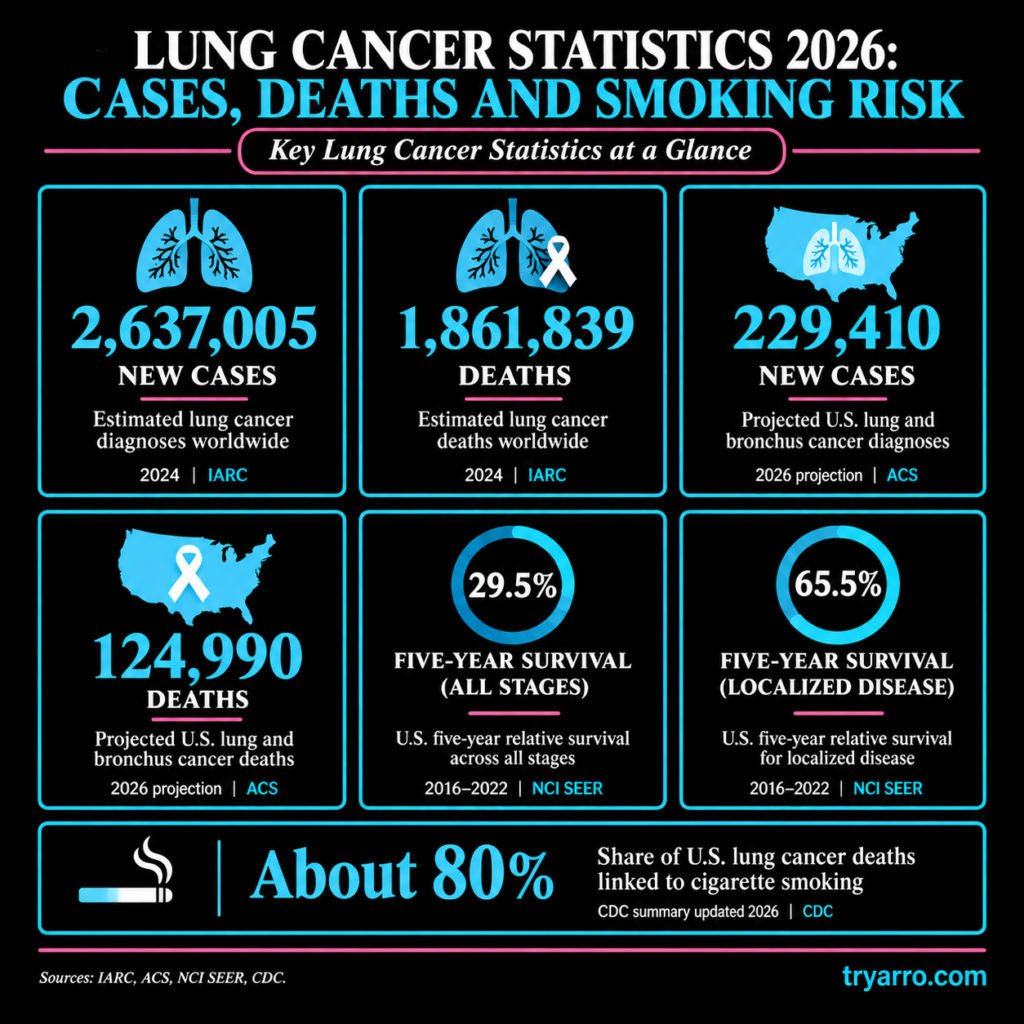
Lung cancer remains the leading cause of cancer death worldwide. The International Agency for Research on Cancer estimates that 2.64 million people developed it and 1.86 million died from it in 2024. In the United States, the American Cancer Society projects 229,410 new cases and 124,990 deaths in 2026. [14][1]
The outlook has improved over time. The latest National Cancer Institute survival data puts five-year relative survival at 29.5% for people diagnosed in 2016–2022, with much higher survival when the disease is found before it spreads. The figures below cover cases, survival, smoking risk and the differences between countries and U.S. states. [2]
Key Lung Cancer Statistics at a Glance
| Statistic | What it measures | Year |
| 2,637,005 new cases | Estimated lung cancer diagnoses worldwide | 2024 |
| 1,861,839 deaths | Estimated lung cancer deaths worldwide | 2024 |
| 229,410 new cases | Projected U.S. lung and bronchus cancer diagnoses | 2026 projection |
| 124,990 deaths | Projected U.S. lung and bronchus cancer deaths | 2026 projection |
| 29.5% | U.S. five-year relative survival across all stages | 2016–2022 diagnoses |
| 65.5% | U.S. five-year relative survival for localized disease | 2016–2022 diagnoses |
| About 80% | Share of U.S. lung cancer deaths linked to cigarette smoking | CDC summary updated 2026 |
Global Lung Cancer Cases and Deaths
The IARC global estimates attribute 12.8% of new cancer diagnoses and 19.1% of cancer deaths worldwide to lung cancer in 2024. It ranked first for both cases and deaths. These figures help explain why lung cancer remains a major public-health concern even as outcomes improve in some countries. [16]
Lung Cancer Cases by Country
China had the largest estimated number of lung cancer cases in 2024. The IARC China factsheet reports 1,175,915 new cases and 743,336 deaths. Population size affects those totals, so a country with more cases does not necessarily have a higher risk for each resident. [17]
Country New cases Deaths Year China 1,175,915 743,336 2024 United States 226,788 129,504 2024 Japan 136,297 90,784 2024 India 112,659 98,687 2024 Russia 67,158 48,647 2024 Germany 61,708 46,821 2024 Indonesia 58,446 53,323 2024 United Kingdom 54,541 36,751 2024 France, metropolitan 47,598 35,915 2024 Brazil 43,788 36,933 2024
Country comparisons become more meaningful when researchers adjust for differences in age. The IARC lung cancer factsheet gives a worldwide age-standardized incidence rate of 23.9 new cases per 100,000 people in 2024. This adjusts for the fact that lung cancer is more common in older populations. [14]
Global Differences by Sex
Worldwide, men accounted for 1,632,033 new lung cancer cases in 2024 and women for 1,004,972, according to the IARC world factsheet. Lung cancer represented 15.4% of all new cancer diagnoses among men and 10.0% among women. [16]
Sex New cases Share of all cancer cases in that sex Year Men 1,632,033 15.4% 2024 Women 1,004,972 10.0% 2024
U.S. Lung Cancer Cases and Deaths in 2026
The American Cancer Society projects slightly more new lung cancer cases among women than men in 2026, but more deaths among men. These estimates use earlier cancer and population data to project the year’s totals. Final registry counts take longer to collect. [1]
Group Projected new cases Projected deaths Projection year All people 229,410 124,990 2026 projection Men 110,910 63,040 2026 projection Women 118,500 61,950 2026 projection
Projected Lung Cancer Cases and Deaths by State
Florida has the highest projected totals in the ACS state estimates, with 18,570 new cases and 9,990 deaths in 2026. California follows with 16,670 cases and 9,580 deaths. The figures are rounded to the nearest ten and describe the expected number of people affected in each state. [18]
State or district Projected new cases Projected deaths Projection years Alabama 3,960 2,370 2026 Alaska 440 210 2026 Arizona 4,350 2,330 2026 Arkansas 2,710 1,640 2026 California 16,670 9,580 2026 Colorado 2,620 1,340 2026 Connecticut 2,670 1,240 2026 Delaware 950 510 2026 District of Columbia 330 150 2026 Florida 18,570 9,990 2026 Georgia 6,780 3,500 2026 Hawaii 870 470 2026 Idaho 1,090 580 2026 Illinois 9,430 4,880 2026 Indiana 6,230 3,430 2026 Iowa 2,500 1,350 2026 Kansas 2,090 1,250 2026 Kentucky 5,060 2,870 2026 Louisiana 3,390 2,080 2026 Maine 1,460 800 2026 Maryland 3,920 2,120 2026 Massachusetts 5,390 2,510 2026 Michigan 8,460 4,850 2026 Minnesota 3,970 2,060 2026 Mississippi 2,660 1,580 2026 Missouri 5,780 3,320 2026 Montana 760 420 2026 Nebraska 1,320 810 2026 Nevada 1,770 1,050 2026 New Hampshire 1,330 630 2026 New Jersey 5,640 2,890 2026 New Mexico 920 590 2026 New York 13,150 5,850 2026 North Carolina 8,880 5,040 2026 North Dakota 480 270 2026 Ohio 10,120 5,550 2026 Oklahoma 3,100 1,920 2026 Oregon 2,970 1,610 2026 Pennsylvania 10,710 5,870 2026 Rhode Island 910 410 2026 South Carolina 4,550 2,400 2026 South Dakota 690 380 2026 Tennessee 6,380 3,690 2026 Texas 14,260 8,080 2026 Utah 790 470 2026 Vermont 590 300 2026 Virginia 6,060 3,300 2026 Washington 5,020 2,570 2026 West Virginia 2,110 1,330 2026 Wisconsin 4,220 2,310 2026 Wyoming 330 210 2026 United States 229,410 124,990 2026
The ACS state tables caution that rounded state estimates may not add up exactly to the U.S. total. Comparing personal risk between states requires rates that account for population size and age. [18]
Lung Cancer Survival by Stage
How far the cancer has spread when it is diagnosed makes a large difference to the statistics. In NCI SEER data, five-year relative survival was 65.5% for localized disease and 10.5% for disease that had spread to distant parts of the body. The estimates cover people diagnosed in 2016–2022. [2]
Stage at diagnosis Five-year relative survival Share diagnosed at this stage Diagnosis years All stages 29.5% 100% 2016–2022 Localized 65.5% 24% 2016–2022 Regional 38.2% 21% 2016–2022 Distant 10.5% 51% 2016–2022 Unknown 17.5% 4% 2016–2022
Relative survival compares survival among people with cancer with survival expected among similar people in the general population. As NCI explains, the result describes groups of patients. Your care team can discuss what the diagnosis, stage and treatment options mean for your own outlook. [2]
Lung Cancer by Age
Lung cancer is most often diagnosed in older adults. The median age at diagnosis was 71 in SEER’s 2019–2023 data. People ages 65–74 accounted for 36.4% of new cases, followed by those ages 75–84 at 28.4%. [2]
Age at diagnosis Share of new cases SEER diagnosis years Younger than 20 0.0% 2019–2023 20–34 0.2% 2019–2023 35–44 0.9% 2019–2023 45–54 4.4% 2019–2023 55–64 20.8% 2019–2023 65–74 36.4% 2019–2023 75–84 28.4% 2019–2023 85 and older 9.0% 2019–2023
In U.S. mortality data for 2020–2024, the median age at lung cancer death was 73. People ages 65–74 accounted for 33.8% of deaths, and those ages 75–84 for 30.9%. The percentages in these age tables are rounded. [2]
Lung Cancer by Sex and Race or Ethnicity
The SEER registry data recorded 52.0 new lung cancer cases per 100,000 men and 43.6 per 100,000 women each year during 2019–2023, after adjusting for age. Among the groups shown below, non-Hispanic Black men had the highest male rate and non-Hispanic White women the highest female rate. [2]
Race or ethnicity Men, rate per 100,000 Women, rate per 100,000 Year All people 52.0 43.6 2019–2023 Hispanic 29.8 23.2 2019–2023 Non-Hispanic American Indian or Alaska Native 53.8 48.6 2019–2023 Non-Hispanic Asian or Pacific Islander 40.8 28.3 2019–2023 Non-Hispanic Black 63.7 42.8 2019–2023 Non-Hispanic White 57.0 50.9 2019–2023
How Lung Cancer Rates Have Changed
U.S. lung cancer rates have fallen over the past two decades. The 2026 Annual Report to the Nation found that new-case rates fell 38% in men and 15% in women from 2003 to 2022. Death rates fell even more, by 52% in men and 37% in women from 2004 to 2023. [13]
Measure Change Period U.S. incidence among men Down 38% 2003–2022 U.S. incidence among women Down 15% 2003–2022 U.S. death rate among men Down 52% 2004–2023 U.S. death rate among women Down 37% 2004–2023
The national report connects that progress with fewer people smoking, more cancers being found early and advances in treatment. Adult cigarette smoking fell from 22% in 2001 to 10% in 2024. The report also identifies screening as an area where more people could benefit. [13]
Smoking and Lung Cancer Risk
Cigarette smoking is linked to about 80% of U.S. lung cancer deaths, according to the CDC. People who smoke cigarettes are 15 to 30 times more likely to develop or die from lung cancer than people who do not smoke. Risk rises with the number of years smoked and the amount smoked each day. [7]
Exposure or group Statistic What it measures Source Cigarette smoking About 80% Share of U.S. lung cancer deaths linked to smoking CDC People who smoke 15–30 times higher Risk of developing or dying from lung cancer compared with people who do not smoke CDC People who never smoked 10–20% Share of U.S. lung cancers in people who never smoked or smoked fewer than 100 cigarettes CDC Secondhand smoke 20–30% higher Lung cancer risk among nonsmoking adults exposed to secondhand smoke CDC Indoor radon About 21,000 deaths annually Estimated U.S. lung cancer deaths attributable to indoor radon EPA
Global Lung Cancer Cases and Deaths
The IARC global estimates attribute 12.8% of new cancer diagnoses and 19.1% of cancer deaths worldwide to lung cancer in 2024. It ranked first for both cases and deaths. These figures help explain why lung cancer remains a major public-health concern even as outcomes improve in some countries. [16]
Lung Cancer Cases by Country
China had the largest estimated number of lung cancer cases in 2024. The IARC China factsheet reports 1,175,915 new cases and 743,336 deaths. Population size affects those totals, so a country with more cases does not necessarily have a higher risk for each resident. [17]
| Country | New cases | Deaths | Year |
| China | 1,175,915 | 743,336 | 2024 |
| United States | 226,788 | 129,504 | 2024 |
| Japan | 136,297 | 90,784 | 2024 |
| India | 112,659 | 98,687 | 2024 |
| Russia | 67,158 | 48,647 | 2024 |
| Germany | 61,708 | 46,821 | 2024 |
| Indonesia | 58,446 | 53,323 | 2024 |
| United Kingdom | 54,541 | 36,751 | 2024 |
| France, metropolitan | 47,598 | 35,915 | 2024 |
| Brazil | 43,788 | 36,933 | 2024 |
Country comparisons become more meaningful when researchers adjust for differences in age. The IARC lung cancer factsheet gives a worldwide age-standardized incidence rate of 23.9 new cases per 100,000 people in 2024. This adjusts for the fact that lung cancer is more common in older populations. [14]
Global Differences by Sex
Worldwide, men accounted for 1,632,033 new lung cancer cases in 2024 and women for 1,004,972, according to the IARC world factsheet. Lung cancer represented 15.4% of all new cancer diagnoses among men and 10.0% among women. [16]
| Sex | New cases | Share of all cancer cases in that sex | Year |
| Men | 1,632,033 | 15.4% | 2024 |
| Women | 1,004,972 | 10.0% | 2024 |
U.S. Lung Cancer Cases and Deaths in 2026
The American Cancer Society projects slightly more new lung cancer cases among women than men in 2026, but more deaths among men. These estimates use earlier cancer and population data to project the year’s totals. Final registry counts take longer to collect. [1]
| Group | Projected new cases | Projected deaths | Projection year |
| All people | 229,410 | 124,990 | 2026 projection |
| Men | 110,910 | 63,040 | 2026 projection |
| Women | 118,500 | 61,950 | 2026 projection |
Projected Lung Cancer Cases and Deaths by State
Florida has the highest projected totals in the ACS state estimates, with 18,570 new cases and 9,990 deaths in 2026. California follows with 16,670 cases and 9,580 deaths. The figures are rounded to the nearest ten and describe the expected number of people affected in each state. [18]
| State or district | Projected new cases | Projected deaths | Projection years |
| Alabama | 3,960 | 2,370 | 2026 |
| Alaska | 440 | 210 | 2026 |
| Arizona | 4,350 | 2,330 | 2026 |
| Arkansas | 2,710 | 1,640 | 2026 |
| California | 16,670 | 9,580 | 2026 |
| Colorado | 2,620 | 1,340 | 2026 |
| Connecticut | 2,670 | 1,240 | 2026 |
| Delaware | 950 | 510 | 2026 |
| District of Columbia | 330 | 150 | 2026 |
| Florida | 18,570 | 9,990 | 2026 |
| Georgia | 6,780 | 3,500 | 2026 |
| Hawaii | 870 | 470 | 2026 |
| Idaho | 1,090 | 580 | 2026 |
| Illinois | 9,430 | 4,880 | 2026 |
| Indiana | 6,230 | 3,430 | 2026 |
| Iowa | 2,500 | 1,350 | 2026 |
| Kansas | 2,090 | 1,250 | 2026 |
| Kentucky | 5,060 | 2,870 | 2026 |
| Louisiana | 3,390 | 2,080 | 2026 |
| Maine | 1,460 | 800 | 2026 |
| Maryland | 3,920 | 2,120 | 2026 |
| Massachusetts | 5,390 | 2,510 | 2026 |
| Michigan | 8,460 | 4,850 | 2026 |
| Minnesota | 3,970 | 2,060 | 2026 |
| Mississippi | 2,660 | 1,580 | 2026 |
| Missouri | 5,780 | 3,320 | 2026 |
| Montana | 760 | 420 | 2026 |
| Nebraska | 1,320 | 810 | 2026 |
| Nevada | 1,770 | 1,050 | 2026 |
| New Hampshire | 1,330 | 630 | 2026 |
| New Jersey | 5,640 | 2,890 | 2026 |
| New Mexico | 920 | 590 | 2026 |
| New York | 13,150 | 5,850 | 2026 |
| North Carolina | 8,880 | 5,040 | 2026 |
| North Dakota | 480 | 270 | 2026 |
| Ohio | 10,120 | 5,550 | 2026 |
| Oklahoma | 3,100 | 1,920 | 2026 |
| Oregon | 2,970 | 1,610 | 2026 |
| Pennsylvania | 10,710 | 5,870 | 2026 |
| Rhode Island | 910 | 410 | 2026 |
| South Carolina | 4,550 | 2,400 | 2026 |
| South Dakota | 690 | 380 | 2026 |
| Tennessee | 6,380 | 3,690 | 2026 |
| Texas | 14,260 | 8,080 | 2026 |
| Utah | 790 | 470 | 2026 |
| Vermont | 590 | 300 | 2026 |
| Virginia | 6,060 | 3,300 | 2026 |
| Washington | 5,020 | 2,570 | 2026 |
| West Virginia | 2,110 | 1,330 | 2026 |
| Wisconsin | 4,220 | 2,310 | 2026 |
| Wyoming | 330 | 210 | 2026 |
| United States | 229,410 | 124,990 | 2026 |
The ACS state tables caution that rounded state estimates may not add up exactly to the U.S. total. Comparing personal risk between states requires rates that account for population size and age. [18]
Lung Cancer Survival by Stage
How far the cancer has spread when it is diagnosed makes a large difference to the statistics. In NCI SEER data, five-year relative survival was 65.5% for localized disease and 10.5% for disease that had spread to distant parts of the body. The estimates cover people diagnosed in 2016–2022. [2]
| Stage at diagnosis | Five-year relative survival | Share diagnosed at this stage | Diagnosis years |
| All stages | 29.5% | 100% | 2016–2022 |
| Localized | 65.5% | 24% | 2016–2022 |
| Regional | 38.2% | 21% | 2016–2022 |
| Distant | 10.5% | 51% | 2016–2022 |
| Unknown | 17.5% | 4% | 2016–2022 |
Relative survival compares survival among people with cancer with survival expected among similar people in the general population. As NCI explains, the result describes groups of patients. Your care team can discuss what the diagnosis, stage and treatment options mean for your own outlook. [2]
Lung Cancer by Age
Lung cancer is most often diagnosed in older adults. The median age at diagnosis was 71 in SEER’s 2019–2023 data. People ages 65–74 accounted for 36.4% of new cases, followed by those ages 75–84 at 28.4%. [2]
| Age at diagnosis | Share of new cases | SEER diagnosis years |
| Younger than 20 | 0.0% | 2019–2023 |
| 20–34 | 0.2% | 2019–2023 |
| 35–44 | 0.9% | 2019–2023 |
| 45–54 | 4.4% | 2019–2023 |
| 55–64 | 20.8% | 2019–2023 |
| 65–74 | 36.4% | 2019–2023 |
| 75–84 | 28.4% | 2019–2023 |
| 85 and older | 9.0% | 2019–2023 |
In U.S. mortality data for 2020–2024, the median age at lung cancer death was 73. People ages 65–74 accounted for 33.8% of deaths, and those ages 75–84 for 30.9%. The percentages in these age tables are rounded. [2]
Lung Cancer by Sex and Race or Ethnicity
The SEER registry data recorded 52.0 new lung cancer cases per 100,000 men and 43.6 per 100,000 women each year during 2019–2023, after adjusting for age. Among the groups shown below, non-Hispanic Black men had the highest male rate and non-Hispanic White women the highest female rate. [2]
| Race or ethnicity | Men, rate per 100,000 | Women, rate per 100,000 | Year |
| All people | 52.0 | 43.6 | 2019–2023 |
| Hispanic | 29.8 | 23.2 | 2019–2023 |
| Non-Hispanic American Indian or Alaska Native | 53.8 | 48.6 | 2019–2023 |
| Non-Hispanic Asian or Pacific Islander | 40.8 | 28.3 | 2019–2023 |
| Non-Hispanic Black | 63.7 | 42.8 | 2019–2023 |
| Non-Hispanic White | 57.0 | 50.9 | 2019–2023 |
How Lung Cancer Rates Have Changed
U.S. lung cancer rates have fallen over the past two decades. The 2026 Annual Report to the Nation found that new-case rates fell 38% in men and 15% in women from 2003 to 2022. Death rates fell even more, by 52% in men and 37% in women from 2004 to 2023. [13]
| Measure | Change | Period |
| U.S. incidence among men | Down 38% | 2003–2022 |
| U.S. incidence among women | Down 15% | 2003–2022 |
| U.S. death rate among men | Down 52% | 2004–2023 |
| U.S. death rate among women | Down 37% | 2004–2023 |
The national report connects that progress with fewer people smoking, more cancers being found early and advances in treatment. Adult cigarette smoking fell from 22% in 2001 to 10% in 2024. The report also identifies screening as an area where more people could benefit. [13]
Smoking and Lung Cancer Risk
Cigarette smoking is linked to about 80% of U.S. lung cancer deaths, according to the CDC. People who smoke cigarettes are 15 to 30 times more likely to develop or die from lung cancer than people who do not smoke. Risk rises with the number of years smoked and the amount smoked each day. [7]
| Exposure or group | Statistic | What it measures | Source |
| Cigarette smoking | About 80% | Share of U.S. lung cancer deaths linked to smoking | CDC |
| People who smoke | 15–30 times higher | Risk of developing or dying from lung cancer compared with people who do not smoke | CDC |
| People who never smoked | 10–20% | Share of U.S. lung cancers in people who never smoked or smoked fewer than 100 cigarettes | CDC |
| Secondhand smoke | 20–30% higher | Lung cancer risk among nonsmoking adults exposed to secondhand smoke | CDC |
| Indoor radon | About 21,000 deaths annually | Estimated U.S. lung cancer deaths attributable to indoor radon | EPA |
Smoking history does not account for every diagnosis. The CDC estimates that 10% to 20% of U.S. lung cancers occur in people who never smoked or smoked fewer than 100 cigarettes in their lifetime. Other risks include secondhand smoke, radon and some workplace exposures. [9]
What Happens to Lung Cancer Risk After Quitting?
The benefits of quitting build over time. The CDC’s smoking-cessation guidance says the added risk of lung cancer drops by about half after ten to 15 years. Added risk means the excess risk linked to smoking above the risk in the general population. [8]
If you are working on quitting, support can help you plan for both nicotine dependence and the routines around smoking. ARRØ’s smoking cessation statistics looks at quit attempts and use of treatment, and its hand-to-mouth habit guide explores the everyday cues people may need to change.
Vaping, Nicotine and Lung Cancer
The World Health Organization says the long-term health effects of e-cigarettes remain incompletely understood. Their aerosols can contain toxic substances, including some that cause cancer. That evidence does not yet give readers a dependable percentage for the lifetime lung cancer risk associated with vaping. [12]
A nicotine label answers a narrower question about a product’s contents. ARRØ describes its nicotine-free range as intended for adults 21 and older and states that the products are not smoking-cessation devices. A nicotine-free label alone cannot establish the safety of an inhaled aerosol. [19]
If these statistics have you thinking about your smoking history, a qualified health professional can help you discuss quitting support and whether screening is appropriate. The CDC identifies tobacco treatment, recommended screening and access to treatment as practical ways to reduce the burden of lung cancer. [13]
Frequently Asked Questions
What Percentage of Lung Cancer Is Caused by Smoking?
Cigarette smoking is linked to about 80% of U.S. lung cancer deaths. An ACS analysis estimates that 86% of U.S. lung cancers are attributable to cigarette smoking. The difference reflects the outcome and method being measured. [1][7]
Can Someone Who Never Smoked Get Lung Cancer?
Yes, about 10% to 20% of U.S. lung cancers occur in people who never smoked. Secondhand smoke, radon, workplace exposures, air pollution and genetic factors can contribute, and some cases have no single identified cause. [9][11]
What Is the Five-Year Survival Rate for Lung Cancer?
The overall U.S. five-year relative survival rate is 29.5% for lung and bronchus cancers diagnosed from 2016 through 2022. The rate is 65.5% for localized disease and 10.5% for distant disease. [2]
Which State Has the Most Projected Lung Cancer Cases?
Florida has the highest projected 2026 count, with 18,570 new cases and 9,990 deaths. State counts are affected by population size and should not be read as incidence or mortality rates. [5][6]
Which Country Has the Most Lung Cancer Cases?
China had the largest estimated number of new lung cancer cases in 2024 at 1,175,915. Its age-standardized incidence rate was 42.9 per 100,000, which allows a fairer age-adjusted comparison with other countries. [4][14]
Does Vaping Cause Lung Cancer?
A dependable human lung-cancer rate attributable to vaping is not yet available. E-cigarette aerosol can contain carcinogenic substances, so uncertainty should not be presented as proof that vaping is safe. ARRØ’s vaping and smoking comparison provides separate consumer context on these exposures, not medical evidence about cancer risk. [12]
Are Nicotine-Free Vapes Safe or Cancer-Preventive?
No authoritative source establishes nicotine-free vaping as safe or as a way to prevent lung cancer. Removing nicotine addresses nicotine exposure, but it does not prove that an inhaled aerosol is harmless. Products marketed as nicotine-free may contain nicotine. [12]
References
[1] American Cancer Society. “Cancer Facts & Figures 2026.” American Cancer Society, 2026. https://www.cancer.org/content/dam/cancer-org/research/cancer-facts-and-statistics/annual-cancer-facts-and-figures/2026/2026-cancer-facts-and-figures.pdf. Accessed 6 Nov. 2026.
[2] National Cancer Institute. “Cancer Stat Facts: Lung and Bronchus Cancer.” Surveillance, Epidemiology, and End Results Program, n.d., https://seer.cancer.gov/statfacts/html/lungb.html. Accessed 6 Nov. 2026.
[3] World Health Organization. “Lung Cancer.” 16 Apr. 2026. https://www.who.int/news-room/fact-sheets/detail/lung-cancer. Accessed 6 Nov. 2026.
[4] Sung, Hyuna, et al. “Global Cancer Statistics 2024: GLOBOCAN Estimates of Incidence and Mortality Worldwide for 34 Cancers in 186 Countries.” CA: A Cancer Journal for Clinicians, 8 July 2026, https://doi.org/10.3322/caac.70090. Accessed 6 Nov. 2026.
[5] American Cancer Society. “Estimated Number of New Cancer Cases by State, 2026.” 2026. https://www.cancer.org/content/dam/cancer-org/research/cancer-facts-and-statistics/annual-cancer-facts-and-figures/2026/mr4-cases-by-state-2026-branded.pdf. Accessed 6 Nov. 2026.
[6] American Cancer Society. “Estimated Number of Cancer Deaths by State, 2026.” 2026. https://www.cancer.org/content/dam/cancer-org/research/cancer-facts-and-statistics/annual-cancer-facts-and-figures/2026/mr5-deaths-by-state-2026-branded.pdf. Accessed 6 Nov. 2026.
[7] Centers for Disease Control and Prevention. “Lung Cancer Risk Factors.” 18 May 2026. https://www.cdc.gov/lung-cancer/risk-factors/. Accessed 6 Nov. 2026.
[8] Centers for Disease Control and Prevention. “Cancer Care Settings and Smoking Cessation.” 15 May 2024. https://www.cdc.gov/tobacco/hcp/patient-care-settings/cancer.html. Accessed 6 Nov. 2026.
 Cessation Cravings: