





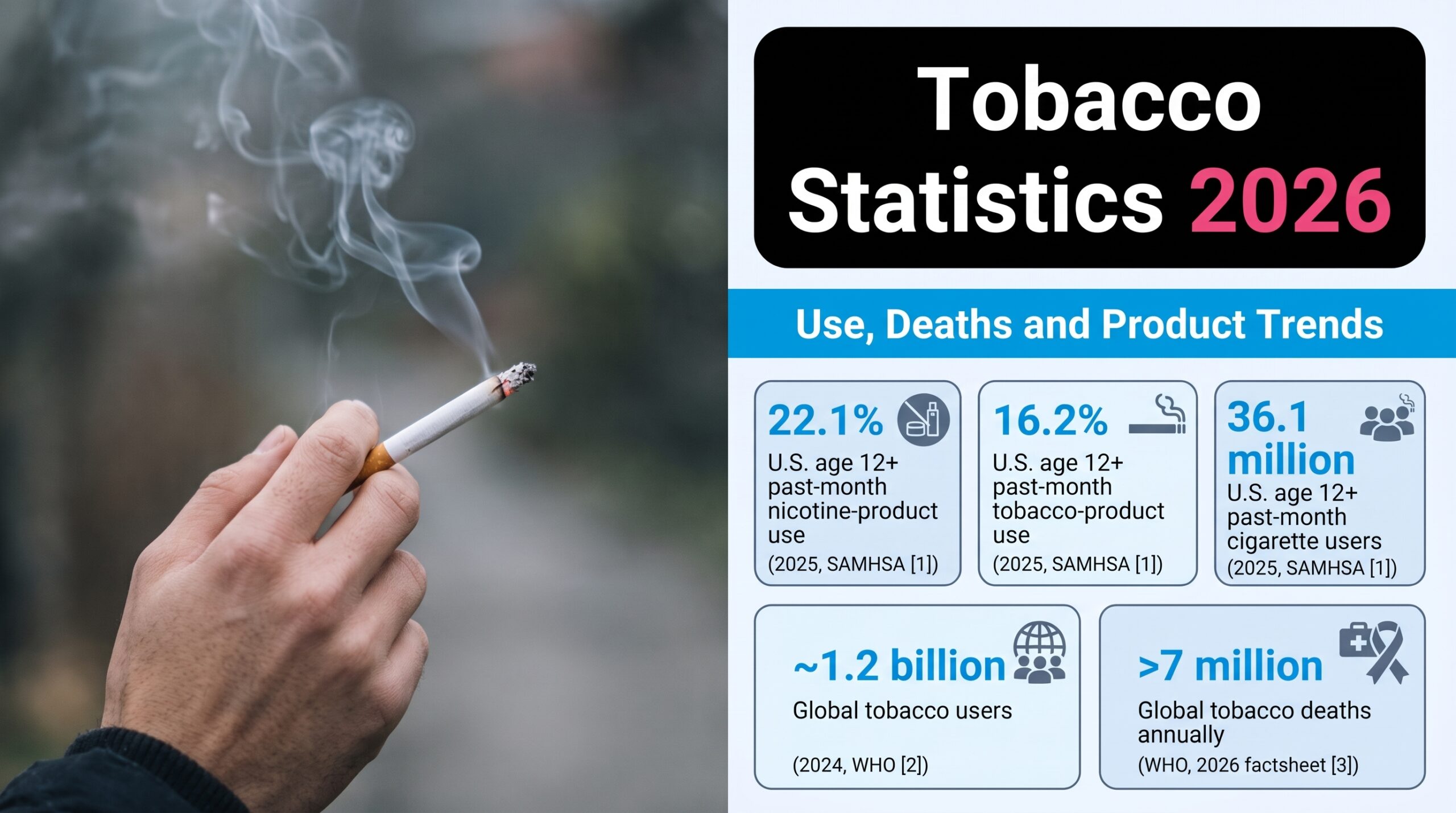
In 2025, 16.2% of U.S. people ages 12 and older reported tobacco-product use in the previous month. The broader nicotine-product rate was 22.1%, according to SAMHSA. The distinction matters because nicotine vaping and tobacco use overlap without being identical categories. [1]
Key Takeaways
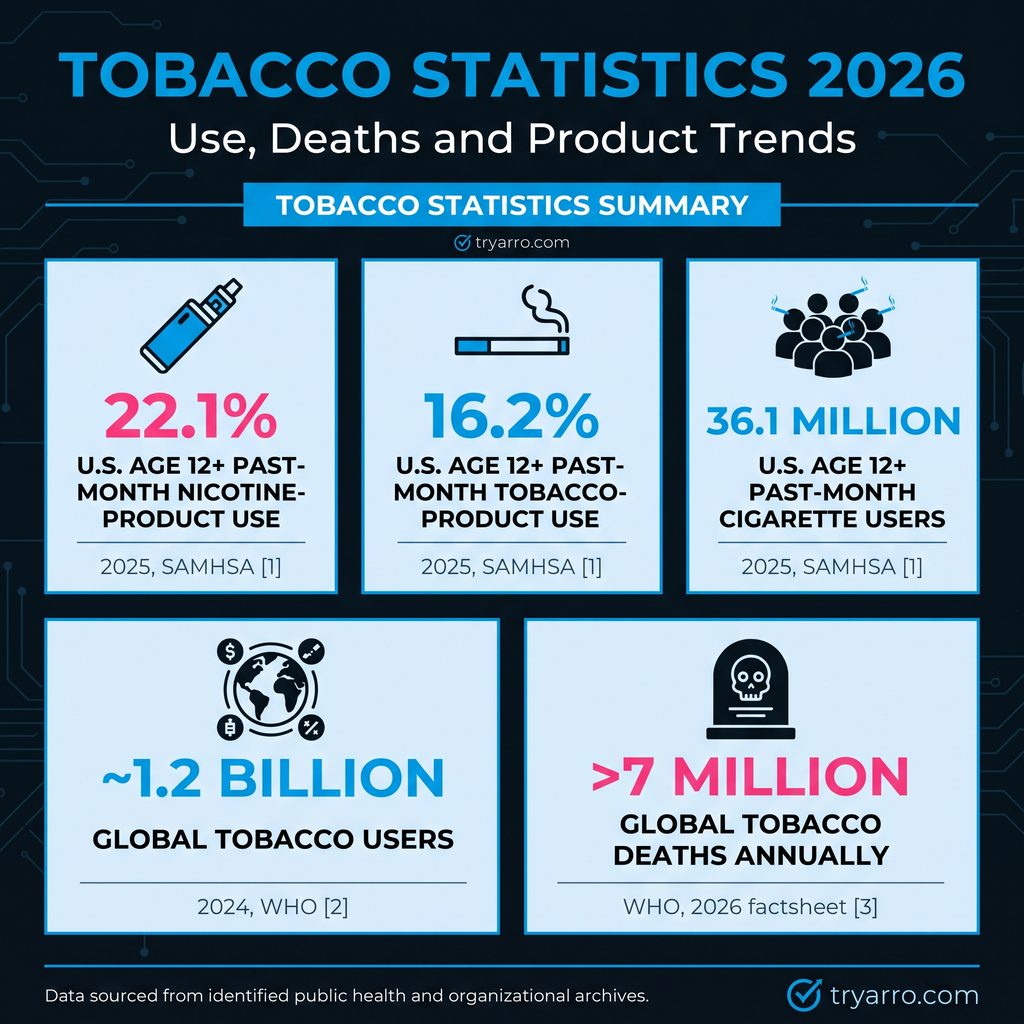
- 22.1% of U.S. people age 12+ reported past-month nicotine-product use in 2025. [1]
- 16.2% of U.S. people age 12+ reported past-month tobacco-product use in 2025. [1]
- 36.1 million people age 12+ reported cigarette smoking in the past month in 2025. [1]
- WHO estimated roughly 1.2 billion global tobacco users in 2024. [2]
- WHO‘s June 2026 factsheet attributes more than seven million deaths annually worldwide to tobacco. [3]
Statistics Summary
| Statistic | What it measures | Year + source |
| 22.1% | U.S. age 12+ past-month nicotine-product use | 2025, SAMHSA [1] |
| 16.2% | U.S. age 12+ past-month tobacco-product use | 2025, SAMHSA [1] |
| 36.1 million | U.S. age 12+ past-month cigarette users | 2025, SAMHSA [1] |
| ~1.2 billion | Global tobacco users | 2024, WHO [2] |
| >7 million | Global tobacco deaths annually | WHO, 2026 factsheet [3] |
How Many Americans Use Tobacco Products?
In the 2025 National Survey on Drug Use and Health, 16.2% of people ages 12 and older reported past-month tobacco-product use. The broader nicotine-product measure was 22.1%, because it also included nicotine vaping. These groups overlap and must not be added together. [1]
How Common Is Cigarette Smoking?
SAMHSA estimated that 36.1 million people ages 12 and older smoked cigarettes in the past month in 2025, or 12.4% of that population. This includes adolescents and differs from adult-only surveys of current smoking. [1]
Cigarettes, Cigars, Smokeless Tobacco and Vaping
The same person can report smoking cigarettes, using smokeless tobacco and vaping nicotine. Product-specific counts therefore do not represent mutually exclusive groups. The survey’s overall estimate is the appropriate measure of unique users. [1]
Global Tobacco Use in 2024
WHO estimated 1.2 billion tobacco users worldwide in 2024, compared with 1.38 billion in 2000. The global series uses different methods and populations from the U.S. NSDUH, so the figures should be compared as separate measures. [2]
Tobacco-Related Disease and Death
WHO‘s 2026 factsheet attributes more than seven million deaths worldwide each year to tobacco, including over 1.6 million among nonsmokers exposed to secondhand smoke. The secondhand-smoke figure is already part of the total. [3]
CDC‘s longstanding U.S. estimate attributes more than 480,000 annual deaths to cigarette smoking and secondhand-smoke exposure. This is an established burden estimate rather than a count of deaths observed during 2026. [4]
Product Trends and Changing Habits
Past-month nicotine vaping reached 10.1% of people ages 12 and older in 2025, compared with 8.3% in the comparable 2022 series. A rise in vaping does not demonstrate a matching fall in smoking because people can use both products. [1]
What Reducing Tobacco Use Can and Cannot Mean
Prevalence surveys describe how common tobacco use is at a given time. They do not show which policies caused a change or predict an immediate proportional change in deaths. Current use and cumulative exposure answer different public-health questions. [1][4]
Age Patterns Across Nicotine Product Categories
Past-month nicotine-product use in 2025 was 27.9% among ages 18–25, 22.9% among adults 26 and older, and 6.9% among ages 12–17. These rates cover the survey’s broader nicotine category, not cigarette smoking alone. [1]
U.S. Tobacco Use From 2021 to 2025
SAMHSA’s comparable series shows past-month tobacco use among people ages 12 and older declining from 20.1% in 2021 to 18.1% in 2022, 17.6% in 2023, 16.7% in 2024 and 16.2% in 2025. The estimated number of users fell from 56.2 million to 46.9 million across that period. [1]
The decline was 3.9 percentage points, calculated from the endpoints. It should not be described as a 3.9% relative reduction. Percentage points describe the subtraction of two rates, while a relative change uses the starting rate as its denominator.
The report notes that some earlier estimates were revised to improve comparability. Using the historical values within the latest report avoids mixing differently weighted versions of the survey into one trend.
Cigarette Smoking Over the Same Period
Past-month cigarette smoking declined from 16.0% in 2021 to 14.6% in 2022, 13.7% in 2023, 13.1% in 2024 and 12.4% in 2025 among people ages 12 and older. The corresponding estimated population fell from 44.8 million to 36.1 million between the first and last years. [1]
The overall cigarette trend does not describe every nicotine product. Nicotine vaping followed a different pattern, and SAMHSA reports it separately before combining products into its broader nicotine measure. A decline in smoking cannot be assumed to equal the same decline in all nicotine use.
Tobacco Use by Age
In 2025, past-month tobacco use was reported by 18.0% of adults ages 26 and older, 14.1% of adults ages 18–25 and 2.0% of adolescents ages 12–17. Those rates represented approximately 41.3 million, 5.1 million and 513,000 people, respectively. [1]
The adult age groups also differed in cigarette use. Past-month smoking was 14.1% among adults ages 26 and older and 9.8% among those ages 18–25. The adolescent estimate was 1.3%, or approximately 340,000 people. [1]
These household-survey age bands differ from school-grade groups in the National Youth Tobacco Survey. Their percentages should not be spliced together as though they came from one study of the same population.
Daily Smoking and Tobacco Product Combinations
Among current cigarette smokers ages 12 and older, 55.1% smoked daily in 2025, representing 19.9 million people. In 2021, the corresponding figures were 61.5% and 27.5 million. The denominator is current cigarette smokers, not everyone in the population. [1]
Among current tobacco users in 2025, 63.5% smoked cigarettes without using another tobacco product, 13.4% smoked cigarettes and used another tobacco product, and 23.0% used other tobacco products without cigarettes. These categories are reported regardless of whether the person also vaped nicotine. [1]
That qualification matters. “Cigarettes without another tobacco product” in this analysis does not necessarily mean cigarettes were the person’s only nicotine product. Survey category labels need to be read in the context of the report’s definitions.
How Many Adults Want to Stop Smoking?
CDC’s analysis of the 2022 National Health Interview Survey found that 67.7% of adults who smoked wanted to quit. A past-year quit attempt was reported by 53.3%, while 8.8% met the study’s definition of recent successful cessation. [5]
Recent successful cessation required having quit for at least six months during the previous year. Wanting to quit, making an attempt and sustaining abstinence are separate outcomes. Their percentages should not be treated as a progression followed by the same people in a clinical trial.
The adult smoking definition in this report also differs from SAMHSA’s past-month measure. CDC required at least 100 lifetime cigarettes and current smoking every day or some days. That difference helps explain why the reports can produce different prevalence estimates.
Use of Cessation Support
Among adults who made a past-year quit attempt or had quit during the previous two years, 38.3% used counseling or medication. Medication use was reported by 36.3%, counseling by 7.3%, and both by 5.3%. Because some people used both, the separate percentages overlap. [5]
Among eligible adults who had seen a healthcare provider, 50.5% received advice to quit and 49.2% received assistance. These figures describe receipt of support, rather than the effectiveness of any particular treatment. [5]
The report also identified differences in access. Among uninsured adults, treatment use was 20.4%. Understanding tobacco use therefore involves more than counting products. Access to support and the outcomes of quit attempts add another part of the picture. [5]
Youth Tobacco Trends in Context
The 2024 National Youth Tobacco Survey estimated that 8.1% of middle and high school students currently used a tobacco product. Among high school students, the rate fell from 12.6% in 2023 to 10.1% in 2024. E-cigarette use accounted for much of that decline. [6]
These findings concern school students and include e-cigarettes within the survey’s tobacco-product framework. They should remain separate from SAMHSA’s narrower tobacco category and its broader nicotine category. A shared word in a report title does not guarantee an identical definition.
Comparing Tobacco Statistics Across Reports
Before comparing two figures, check the product, population and recall period. “Any tobacco,” “cigarette smoking” and “nicotine use” can include different behaviors. Past-month use also differs from lifetime experimentation or daily use.
A prevalence survey describes how common a behavior is. Mortality estimates describe attributable deaths, often reflecting years of prior exposure. Cessation research describes attempts and outcomes. Reading those measures together provides a more useful view of tobacco’s burden than using any single percentage as a substitute for the rest.
Frequently Asked Questions
How many people worldwide use tobacco?
WHO estimated 1.2 billion tobacco users in 2024. This global estimate is distinct from counts of nicotine vaping and U.S. survey findings. [2]
Are nicotine use and tobacco use the same statistic?
No. In NSDUH, the nicotine-product measure includes nicotine vaping in addition to tobacco products. The categories overlap. [1]
Can the product-specific counts be added together?
No. People can use more than one product, so summing the groups would double-count some respondents. [1]
Understanding the Wider Tobacco Picture
Use rates and health outcomes need separate measures. ARRØ’s smoking statistics provide additional context on cigarette use by age and location.
For quit attempts and sustained abstinence, see the separate smoking cessation statistics.
References
- Substance Abuse and Mental Health Services Administration. “Key Substance Use and Mental Health Indicators in the United States: Results from the 2025 National Survey on Drug Use and Health.” HHS Publication PEP26-07-010, 2026.
- World Health Organization. “WHO Tobacco Trends Report: 1 in 5 Adults Still Addicted to Tobacco.” 6 Oct. 2025.
- World Health Organization. “Tobacco and Nicotine.” 2026. Accessed 23 Nov. 2026.
- Centers for Disease Control and Prevention. “Cigarette Smoking.” 17 Sept. 2024.
- VanFrank, Brenna, et al. “Adult Smoking Cessation: United States, 2022.” MMWR, vol. 73, 2024, pp. 633–641.
- Centers for Disease Control and Prevention. “Tobacco Product Use Among Middle and High School Students: National Youth Tobacco Survey, United States, 2024.” MMWR, vol. 73, 2024.
 Cessation Cravings: